
Five articles published in the journal “Nature Communications” – available here: they are the ones published on July 30, 2024, among those on the subject – report different analyses of data collected by NASA’s DART spacecraft and the Italian Space Agency’s LICIACube nanosatellite that accompanied it on its mission that ended with the collision with Dimorphos, a small satellite asteroid of Didymos, which occurred on September 26, 2022. Various teams of researchers with members in common offered possible reconstructions of the processes that led to the formation of the pair of asteroids and their characteristics. These studies are connected to the defense of the Earth from asteroid impacts.
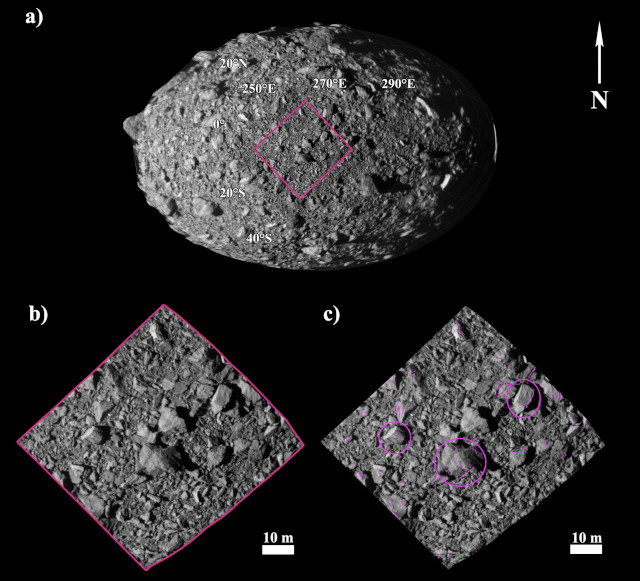
The image (NASA/Johns Hopkins Apl) shows an image of the asteroid Dimorphos (a) with a magnified area (b) that was analyzed in one of the articles and a mapping of the fractures of the boulders (c).
The DART spacecraft captured images of the two asteroids, but especially of Dimorphos, during its approach, culminating in its crash. Until the end, it sent these images, and the LICIACube nanosatellite, which had separated from DART, sent other images that integrated those of the NASA spacecraft.
The DART mission was intended to gather information on the possibilities of deviating the trajectory of an asteroid potentially dangerous for the Earth. The consequences of the impact of DART are the primary interest, but it’s essential to know the characteristics of an asteroid to be able to alter its orbit.
In the case of Didymos and Dimorphos, it’s crucial to keep in mind that they are made of rubble and not solid rock. Different collisions between asteroids can generate different clouds of debris, and this means that there may be different “generations” of asteroids that formed in this way at separate times.
Previous studies showed that sunlight can make an asteroid spin. If it’s like Didymos, when it starts spinning like a top, it deforms by swelling in the middle and losing pieces. Slowly, the various pieces of Didymos created a ring around it that ended up joining together in its moon Dimorphos. These two asteroids have a greater amount of large boulders than other asteroids visited by space missions and this could be a characteristic of binary asteroid systems.
Another result of the analysis indicates that asteroids like Didymos and Dimorphos are prone to fractures due to the day/night cycle that can cause thermal stress even without the presence of water thawing and freezing. This is essential when thinking about a mission that generates an impact on an asteroid of this type because it would influence the consequences. From this point of view, the researchers would have expected to find dust produced by that process near Didymos and Dimorphos. Its absence could be due to the young age of this pair and this could mean that only the first fractures formed.
Many details are emerging from the analysis of data collected during the DART mission. In an international collaboration between space agencies that are working to plan the defense of the Earth from a potential asteroid impact, ESA is developing the Hera mission: in October, a spacecraft is scheduled to be launched to the area of Didymos and Dimorphos, where it’s scheduled to arrive in late 2026. The aim is to examine the consequences of the impact of the DART spacecraft from its vicinity and therefore in detail. This will provide new information useful for planning a mission capable of diverting the trajectory of a truly dangerous asteroid.
