August 2024

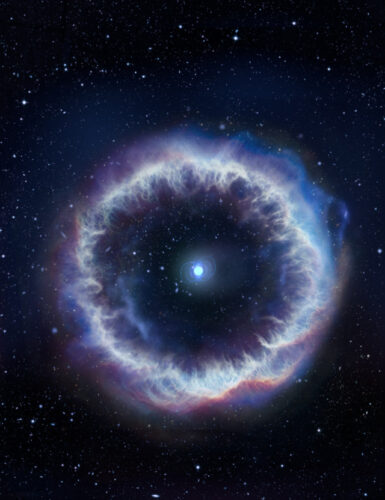
Artist's illustration of a magnetar surrounded by a plasma bubble (Image S. Dagnello, NSF/AUI/NRAO)

An article published in the journal “Nature” reports the results of a study on some fast radio bursts linked to persistent emissions that associates that long duration with a bubble of plasma that generates that radiation. A team of researchers led by the Italian National Institute for Astrophysics registered and studied the fast radio burst with the weakest persistent emission detected so far, cataloged as FRB20201124A, and two other similar events with the VLA radio telescope collecting data that provide evidence of the presence of the plasma bubble at the origin of the radio emissions.

The Cygnus cargo spacecraft captured by the Canadarm2 robotic arm on NG-21 mission (Image NASA TV)

Northrop Grumman’s Cygnus spacecraft, launched last Sunday, August 4, has just reached the International Space Station and was captured by the Canadarm2 robotic arm. Astronaut Matthew Dominick, assisted by his colleague Jeanette Epps, will soon begin the slow maneuver to move the Cygnus until it docks with the Station’s Unity module after about two hours.

The Cygnus cargo spacecraft arrived on schedule despite some issues with a thruster burn that was scheduled to occur about 45 minutes after separation from SpaceX’s Falcon 9 rocket’s last stage. Initial reports indicated that the onboard computer had canceled the burn due to low pressure within the engine systems. Northrop Grumman engineers were able to compensate for the issue with a new burn schedule after reviewing pressure data and determining that it was still acceptable for the thrusters to work.

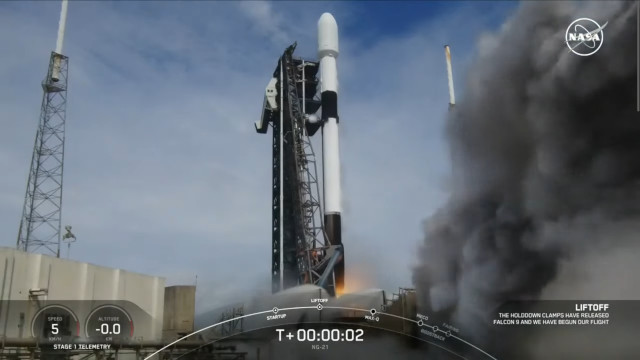
Cygnus cargo spacecraft blasting off atop a SpaceX Falcon 9 rocket (Image NASA TV)

A little while ago, Northrop Grumman’s Cygnus spacecraft blasted off atop a SpaceX Falcon 9 rocket from the Kennedy Space Center on its NG-21 or CRS NG-21 mission. After about 15 minutes, it successfully separated from the rocket’s last stage and set on its course. This is the second of at least three resupply missions to the International Space Station with various payloads launched using the Falcon 9 rocket while waiting for the new version of Northrop Grumman’s Antares rocket to be ready.

An image of the asteroid Dimorphos (a) with a magnified area (b) that was analyzed in one of the articles and a mapping of the fractures of the boulders (c)

Five articles published in the journal “Nature Communications” report different analyses of data collected by NASA’s DART spacecraft and the Italian Space Agency’s LICIACube nanosatellite that accompanied it on its mission that ended with the collision with Dimorphos, a small satellite asteroid of Didymos, which occurred on September 26, 2022. Various teams of researchers with members in common offered possible reconstructions of the processes that led to the formation of the pair of asteroids and their characteristics. These studies are connected to the defense of the Earth from asteroid impacts.