October 2024

Artist's illustration of Gliese 229 Ba and Gliese 229 Bb with Gliese 229 A (Image courtesy K. Miller, R. Hurt (Caltech/IPAC))

Two articles, one published in the journal “Nature” and one in “The Astrophysical Journal Letters”, report the results of two independent studies on Gliese 229 B, the first brown dwarf whose existence was confirmed, which conclude that it’s actually a pair of close brown dwarfs. A team led by Caltech researcher Jerry Xuan used the GRAVITY and CRIRES+ instruments mounted on ESO’s VLT in Chile while a team led by Sam Whitebook, also from Caltech, and Tim Brandt of the Space Telescope Science Institute in Baltimore, used the NIRSPEC instrument installed at the Keck Observatory in Hawaii. There were already suspicions about the nature of Gliese 229 B due to some inconsistencies detected in its characteristics but only now was it possible to find the evidence.

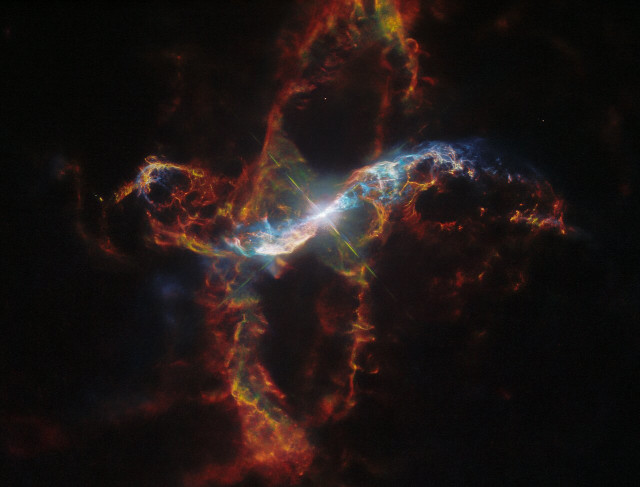
R Aquarii (NASA, ESA, M. Stute, M. Karovska, D. de Martin & M. Zamani (ESA/Hubble))

An image captured by the Hubble Space Telescope depicts R Aquarii, a binary system consisting of a red giant and a white dwarf. Four different filters of the WFC3 (Wide Field Camera 3) instrument were used in visible light to create the most recent observation of R Aquarii conducted with Hubble. This allowed to examine the changes that have occurred in particular in the nebula surrounding the pair.

The R Aquarii system is in the cosmic neighborhood, being about 650 light-years from Earth. For this reason, it has been the subject of study with different instruments since the two stars that make up the pair, which are invisible to the naked eye, were discovered. For example, it was the subject of a test using a subsystem of the SPHERE instrument installed on ESO’s VLT in Chile.

NASA's Europa Clipper space probe blasting off atop a SpaceX Falcon Heavy rocket (Photo NASA)

A few hours ago, NASA’s Europa Clipper space probe blasted off atop a SpaceX Falcon Heavy rocket from the Kennedy Space Center. After just over an hour, it successfully separated from the rocket’s last stage and set off on its route that will take it into deep space, to Europa, Jupiter’s moon with an icy surface that hides an ocean of liquid water to understand if it’s habitable.

Super Heavy 12 and Starship 30 blasting off (Image courtesy SpaceX)

SpaceX conducted a new flight test of its Super Heavy rocket and Starship prototypes, launched from its base in Boca Chica, Texas. This is the fifth test involving the entire system of Elon Musk’s company which is supposed to revolutionize space travel with an unprecedented transport capacity and being totally reusable. They are advanced prototypes with the Super Heavy identified as Booster 12 and the Starship identified as Starship 30 or Ship30 or simply S30.

Each test leads to new changes to the vehicles’ systems, and this was also true after the fourth test conducted on June 6, 2024. The scheduled breakthrough was in the test of the system called Mechazilla, the structure attached to the launch pad that also has the purpose of capturing the Super Heavy when it returns after launching the Starship.

The REBELS-25 galaxy as seen by the ALMA radio telescope (Image ALMA (ESO/NAOJ/NRAO)/L. Rowland et al.)

An article accepted for publication in the journal “Monthly Notices of the Royal Astronomical Society” reports the discovery of a primordial galaxy that was cataloged as REBELS-25 and shows a rotating structure that is already ordered in a way that isn’t expected from such an ancient galaxy. A team of researchers used the ALMA radio telescope to study REBELS-25 and trace the movement of gas within it. The data collected will be invaluable in understanding how a galaxy that we see as it was when the universe was about 700 million years old can have a structure that is already becoming a spiral like the one of the Milky Way at that time.