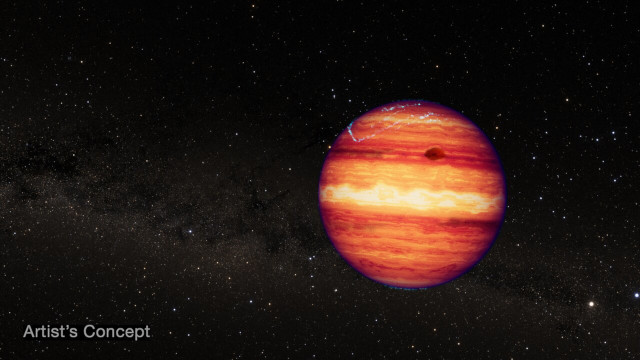
An article published in “The Astrophysical Journal Letters” reports the results of a study of the super-Jupiter object cataloged as SIMP J013656.5+093347.3 and referred to as SIMP J0136+09 or simply SIMP 0136. A team of researchers used observations conducted with the James Webb Space Telescope to monitor the infrared emissions from this object. Its nature is still undetermined because it has an estimated mass of around 13 times Jupiter’s, at the boundary between a planet and a brown dwarf. The result is the discovery of an atmosphere that varies quickly, probably due to layers of clouds with different chemical compositions.
SIMP 0136 has been known since 2003 but its limited emissions made it difficult to study. It’s in the cosmic neighborhood since it’s about 20 light-years away from Earth and doesn’t orbit around any star that might disturb observations with its light. However, even its nature is uncertain, as it could be a gas giant of the rogue planet type or a brown dwarf. It took the power and sensitivity of the James Webb Space Telescope to obtain details of its atmosphere, which proved to be peculiar.
The observations of SIMP 0136 indicate that its day is just over 140 minutes long. The James Webb Space Telescope observed it for two of its days using the NIRSpec (Near-Infrared Spectrograph) instrument to conduct spectral examinations at different wavelengths. That allowed to detect the signatures of chemicals in the object’s atmosphere.
Allison McCarthy, a doctoral student at Boston University and the study’s lead author, explained that the different wavelengths provide information about the different depths of SIMP 0136’s atmosphere. She and her colleagues started understanding that wavelengths with the most similar light curve shapes probed the same depths, which strengthens the idea that they must be produced by the same mechanism.
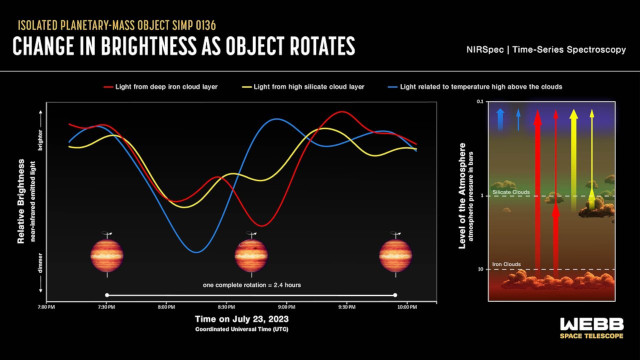
For example, one group of wavelengths (in red in the infographic below) originates deep in the atmosphere where there may be patchy clouds made of iron particles. A second group (in yellow in the infographic below) comes from higher clouds that may be made of tiny grains of silicate. The variations in the light curves of both wavelengths appear to be linked to patchy cloud layers.
A third group (in blue in the infographic below) of wavelengths originates at very high altitudes, far above the clouds, and appears to follow temperatures. Bright patches may be linked to auroras that were previously detected at radio waves, or to gas rising from deep in the atmosphere.
Some light curves can’t be explained by clouds or temperatures, instead, they show variations connected to the chemistry of atmospheric carbon. There may be pockets of carbon dioxide rotating in and out of view, or chemical reactions causing changes in the atmosphere over time.
Johanna Vos from Trinity College Dublin, a co-author of the article, admitted that the researchers don’t yet understand the chemistry on SIMP 0136, but the results obtained are exciting because they show that the abundance of molecules such as methane and carbon dioxide can change from place to place over time. This means that a single measurement may not be representative of the entire planet (or brown dwarf).
Because of these variations, the researchers stressed the importance of observations that cover several rotations of SIMP 0136 to understand the atmospheric mechanisms at work. In essence, the studies continue in order to deepen our knowledge of this object, understand its nature, and what happens in its atmosphere. These are mechanisms that may be common to other gas giants, whether they are planets in the solar system, exoplanets, or brown dwarfs. The James Webb Space Telescope is proving invaluable for this type of research as well.
The bottom image (NASA, ESA, CSA, J. Olmsted (STScI)) shows an infographic with various light curves obtained by observing SIMP 0136 with the James Webb Space Telescope’s NIRSpec instrument.