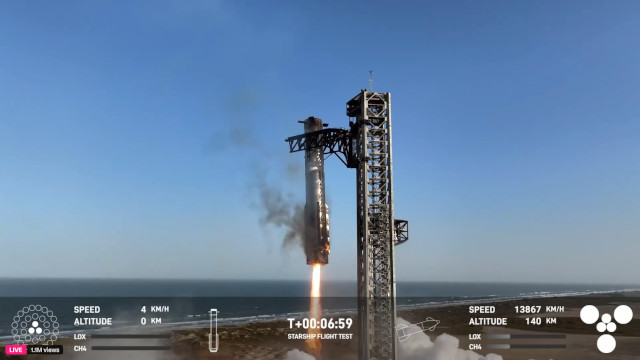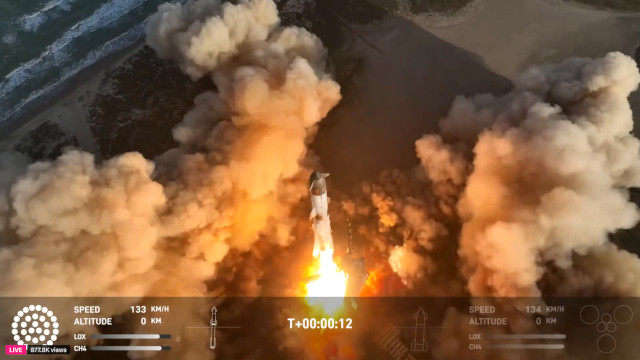
It was the afternoon in the USA when SpaceX conducted a new flight test of its Super Heavy rocket and Starship prototypes, launched from its base in Boca Chica, Texas. This is the 8th test involving the entire system of Elon Musk’s company which is supposed to revolutionize space travel with an unprecedented transport capacity and being totally reusable. They are advanced prototypes with the Super Heavy identified as Booster 15 and the Starship Block 2 identified as Starship 34 or Ship34 or simply S34.
Starship 34 was the second in the Block 2 version, larger than the first version because the liquid methane and oxygen tanks are larger. The 7th test conducted on January 16, 2025, was a step back due to the explosion of the Starship 33 prototype. According to SpaceX statements, the higher-than-expected stresses had probably caused damage with a loss of propellant and consequent problems with an engine. For this reason, Starship 33 had exploded a few minutes after its separation from the Super Heavy.
Starship 34 was supposed to continue with Block 2 the plan to test the resistance of Starship by pushing it to its limits to verify how much it can withstand stress, especially during the reentry and landing phase. The flight was also important because it was supposed to test the Starlink satellite deploying system using simulators.
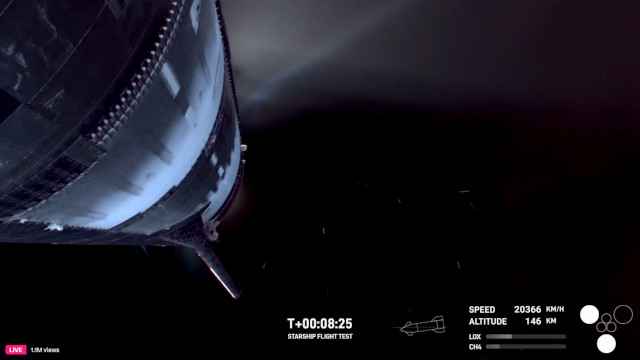
SpaceX made some changes that were supposed to eliminate the problems by reducing vibrations but apparently they were not enough. Just over 8 minutes after launch, one of Starship 34’s vacuum-optimized Raptor engines shut down prematurely, and the three central engines also shut down shortly thereafter. With two engines burning, Starship lost its attitude and started spinning due to the asymmetric burn. At that point, the activation of the system that caused the prototype to explode was inevitable.
The landing of Super Heavy 15 remains a positive part of the test, even if two of its engines didn’t start during the maneuver. This rocket can maneuver even with fewer than the 13 engines that are supposed to start during the landing phase and it proved it yesterday. In the 7th test, only one of the engines hadn’t started during the landing.
The 8th test brutally showed the problems of Starship Block 2. Elon Musk’s philosophy has always been to conduct these tests even when there’s a high probability of failure but frankly, more was expected from an advanced prototype like the Starship 34. Perhaps, the SpaceX team didn’t have enough time to make the necessary improvements after the 7th test, and this is one of the evaluations that will have to be made in the analysis of yesterday’s test.
There’s clearly still a lot of work to do before the Starship can transport an actual payload. It’s possible that at this point, SpaceX decides to switch to version 3 of the Raptor engines, which in the company’s ideas should solve at least most of the problems. Progress also passes through these problems but if Elon Musk wants to talk about Mars, he would do better to show some.