
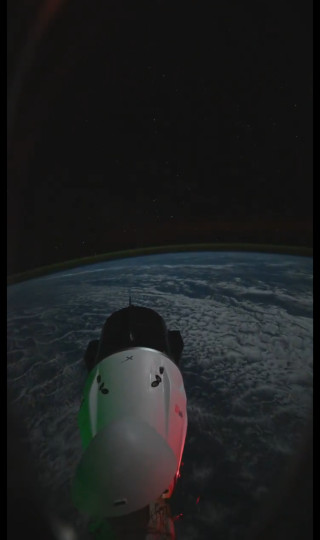
 A few hours ago, SpaceX’s Crew Dragon Endurance spacecraft docked with the Harmony module of the International Space Station completing the first part of its Crew-10 or SpaceX Crew-10 mission that began with its launch about 28.5 hours earlier. After checking that the pressure gets properly balanced, the hatch will be opened to allow Anne McClain, Nichole Ayers, Takuya Onishi, and Kirill Peskov to enter the Station and start their mission, which will last about five months.
The image (Courtesy Don Pettit) shows the Crew Dragon Endurance spacecraft docking with the Harmony module as seen from inside the International Space Station.
The Crew Dragon spacecraft is equipped with an automated docking system to the International Docking Adapter (IDA). The approach procedure, with safety as the top priority, has been extensively tested during previous missions of the Crew Dragon spacecraft.
The Crew-10 mission’s crew was added to Expedition 72 and met the Crew-9 mission’s crew, who is scheduled to depart the Station in a couple of days. Normally, the crews of two missions work together for about a week to minimize potential problems in the transition of the various tasks they perform on the Station. However, in this case, NASA has decided to shorten this transition to limit the consumption of food, water, and oxygen. This unusual measure is due to a delay in the next mission of the Cygnus space cargo ship, originally scheduled for early 2025 and postponed by several months due to damage suffered by the Cygnus during its transport to Cape Canaveral. The Station crew has large supplies of the goods necessary for their survival but it was decided to limit their extra use.
Astronauts Butch Wilmore and Suni Williams, who arrived at the International Space Station on the Starliner Calypso, have become part of the Crew-9 mission and will return to Earth on the Crew Dragon Freedom due to the problems encountered by the Calypso’s engines during the Boeing Crew Flight Test mission. The story has unfortunately become part of a political dispute and incorrect or downright false information has been spread in recent months. We can hope that their return to Earth will bring attention back to the Station’s scientific activities.
