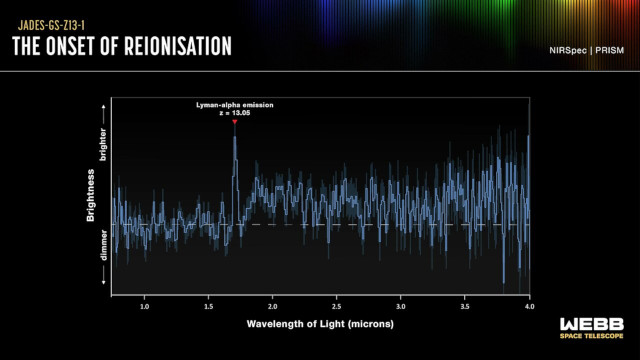
An article published in the journal “Nature” reports the results of observations of the primordial galaxy cataloged as JADES-GS-z13-1. A team of researchers used the James Webb Space Telescope to examine this galaxy, estimating that it dates back to about 330 million years after the Big Bang. The surprise came from spectroscopic analyses with so-called Lyman-alpha radiation, emitted in the ultraviolet by hydrogen in specific circumstances, because it was much stronger than would be expected from a galaxy of that era.
During its first billion years of life, the universe was dark because neutral hydrogen absorbed the emissions of primordial stars. Roberto Maiolino of the University of Cambridge and University College London, one of the authors of this study, compared that situation to a dense fog of neutral hydrogen.
The universe became the bright place we know thanks to reionization, the process that led to hydrogen being ionized. For this reason, astronomers expect to see strong ultraviolet hydrogen emissions of the type called Lyman-alpha only in galaxies we see as they were after the end of the epoch of reionization. The Lyman-alpha radiation detected in the galaxy JADES-GS-z13-1 is, therefore, surprising.
The observations of the galaxy JADES-GS-z13-1 were conducted as part of the James Webb Space Telescope Advanced Deep Extragalactic Survey (JADES), which also identified what is currently the most distant galaxy known. The Near-Infrared Camera (NIRCam) instrument was used to capture the images and for the initial estimates of the distances of the detected objects, while the Near-Infrared Spectrograph (NIRSpec) instrument provided the additional information that led among other things to precise estimates of the distances.
The examination of the traces left in the electromagnetic emissions made possible by NIRSpec allowed the intense Lyman-alpha radiation to be detected. This is an ultraviolet emission, but the redshift was so great due to the enormous distance covered that it was detected from Earth in the near infrared.
At least for now, we can only speculate on the origin of that intense Lyman-alpha radiation. One possibility is that the first stars in the universe, much bigger and more massive than those that formed in later epochs, that ionized the hydrogen so early. Another possibility is that the galaxy JADES-GS-z13-1 contained an active galactic nucleus powered by a primordial supermassive black hole that could already ionize a wide area of space.
The researchers plan to conduct new follow-up observations of the galaxy JADES-GS-z13-1 to gain new information in the hope of finding the origin of the intense Lyman-alpha radiation. This would be an important result in the research about the epoch of reionization, a crucial period in the history of the universe.
Three papers published in June 2023 in “The Astrophysical Journal” reported various aspects of a study on the epoch of reionization and provided evidence that the first galaxies transformed the universe from a place of opaqueness to the current place where light can spread. The study of the galaxy JADES-GS-z13-1 could add to the evidence and perhaps even find the traces of the first generation of stars in the universe. The James Webb Space Telescope is providing results that are bringing advances in astronomy, and we can expect more.
The bottom image (ESA/Webb, NASA, CSA, STScI, J. Olmsted (STScI), S. Carniani (Scuola Normale Superiore), P. Jakobsen) shows the results of the spectroscopic detections of the galaxy JADES-GS-z13-1 with the Lyman-alpha emissions indicated by the red arrow.