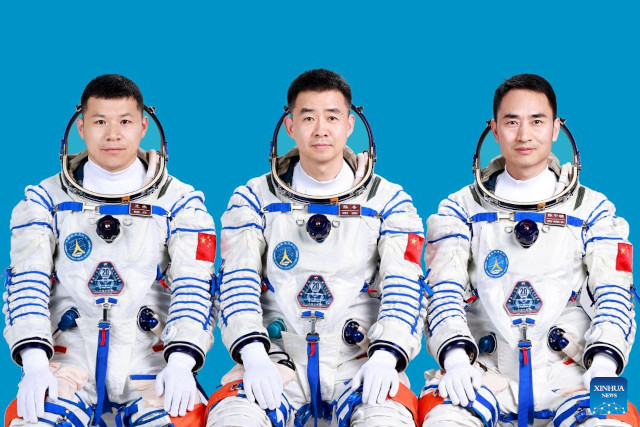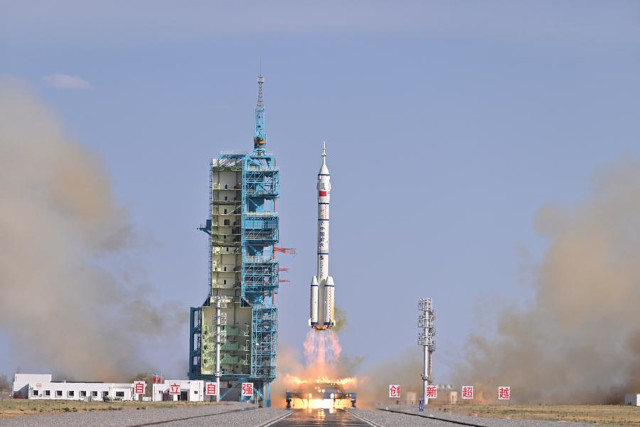
A confirmation has arrived that three Chinese taikonauts from the Shenzhou 20 mission reached the Chinese space station Tiangong with an automated docking maneuver. They blasted off about 6.5 hours earlier atop a Long March-2F rocket from the Jiuquan Satellite Launch Center. They form the 9th crew of the Chinese space station and will remain there for about six months, the standard duration for a mission.
The three taikonauts, as the Chinese call their astronauts, of the Shenzhou 20 mission are Chen Dong, Chen Zhongrui, and Wang Jie. Information about these taikonauts is scant even by China’s standards, where the new Tiangong space station’s crew members are revealed in general the day before launch. It’s possible that information about the two taikonauts on their first space mission was stuck in the bureaucracy of some ideological evaluation committee, and only the ritual photos were released before they appeared in the phases that lead to the launch, which are filmed by some authorized broadcaster.
We know that Chen Dong, 47, is a senior colonel (a rank equivalent to a brigadier general) in the Chinese Air Force, information available thanks to the fact that in 2016 he was part of the crew of the Shenzhou 11 mission and in 2022 of the Shenzhou 14 mission, in the latter case with the command of the Tiangong space station during the period in which the Tianhe core module was expanded with the two space laboratories. This veteran taikonaut is also the commander of the Shenzhou 20 mission.
It was announced that the taikonauts of the Shenzhou 19 mission will return to Earth on April 29, so they met with their replacements from the Shenzhou 20 mission and the two crews will work together for a few days. This practice allows the station to be constantly inhabited and has become routine.
The Chinese authorities never reveal much about the activities that the taikonauts conduct on the Tiangong space station beyond general information on scientific experiments, educational activities conducted for Chinese students, outreach to the general population, and possible spacewalks.
During the Shenzhou 20 mission, it’s possible that the first launch of the new Qingzhou cargo spacecraft will be conducted. Its development and launch are linked to that of a new carrier rocket, the Kinetica 2 (Lijian 2), so the mission schedules may still undergo significant changes. However, it shows that the Chinese space program continues to make progress. China’s ambitions in space must be taken seriously, to the point that, for example, it’s unclear whether American astronauts will return to the Moon before some taikonauts get there.