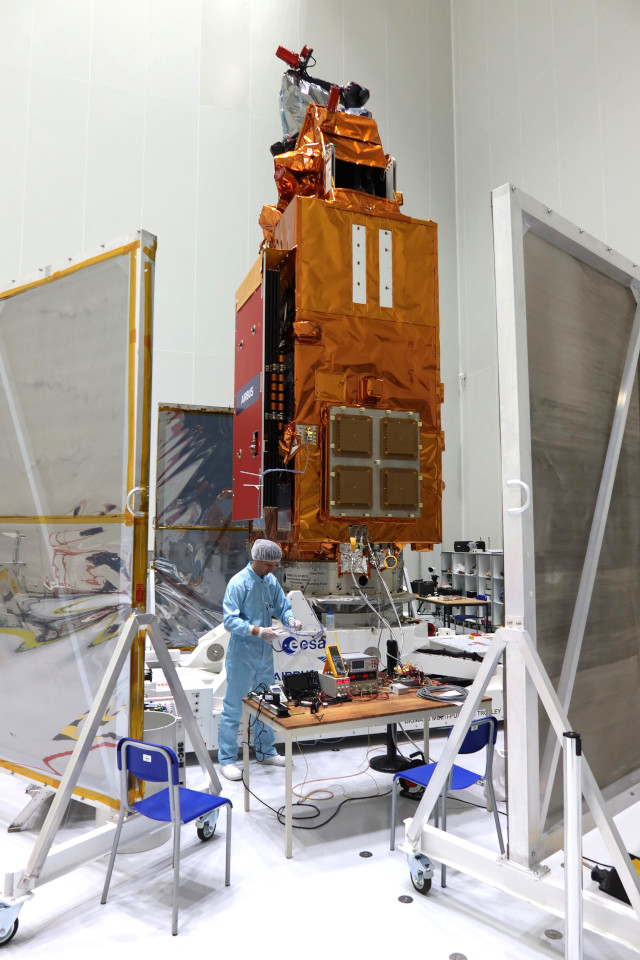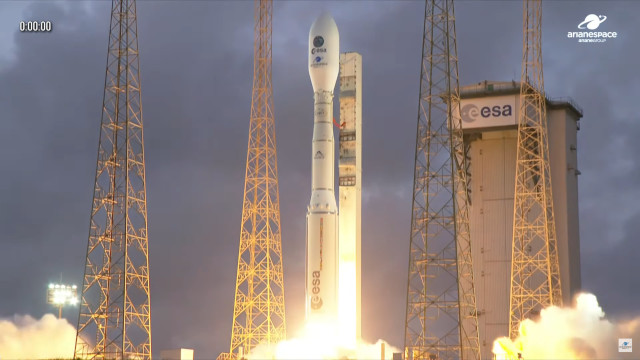
A little while ago, the Biomass satellite was launched atop a Vega-C rocket from the Kourou base in French Guiana. After about 58 minutes, it successfully separated from the rocket’s last stage and set off on a course that will take it to its Sun-synchronous orbit at an altitude of 666 kilometres, where it will study the biomass of forests around the world. This work will help us better understand the global carbon cycle and forest ecosystems.
The Biomass satellite’s orbit is Sun-synchronous, meaning it passes over a certain area of the Earth at the same local solar time every day. This satellite is relatively small at 1,170 kilograms and relatively simple with a main instrument, a P-band synthetic aperture radar and a 12-metre antenna. It’s part of ESA’s Living Planet Programme, which includes various satellites. That’s because each mission is specialised in collecting a certain type of information that will then be used in various combinations depending on the needs of the various scientific studies.
In the case of the Biomass satellite, continuous measurements of forest biomass will be crucial in a monitoring that will begin what was called the forest space age. It’s the first time that a satellite is equipped with a P-band synthetic aperture radar, an instrument that will allow monitoring even in the densest forests to measure the characteristics of trees, even in areas where most of the carbon is accumulated.
Obtaining precise information on forests is important in reconstructing the global carbon cycle. This information is crucial for various types of environmental studies that aim to understand the health of forests. This information can be combined with that collected by other instruments in orbit and in the forests themselves by people who carry out monitoring and measurements of various types. All this will improve the quality of studies on the changes that are occurring in forests.
The Biomass satellite regularly started communicating with the mission control center. It will be tested for a few weeks to verify that everything is working properly and that the antenna is being deployed correctly. If all goes well, at the end of the tests, it will begin its primary mission, which will last 5 years.