
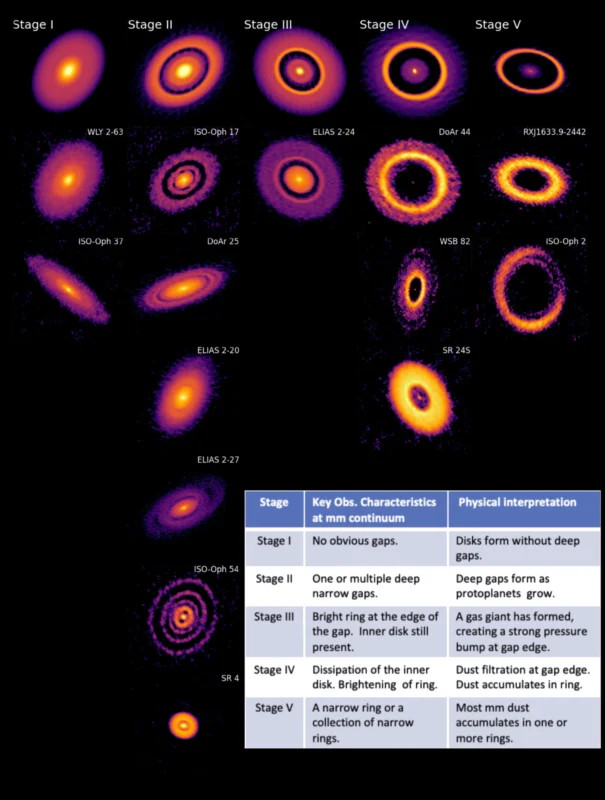
An article published in “The Astrophysical Journal Letters” reports a model that traces the evolution of protoplanetary disks through five stages. A team of researchers from the ODISEA (Ophiuchus DIsc Survey Employing ALMA) project developed this model using both simulations and observations of protoplanetary disks within the Ophiuchus molecular cloud obtained using the ALMA radio telescope. The type of evolution observed confirms the division into stages proposed in 2020 in an article published in the journal “Monthly Notices of the Royal Astronomical Society” and offers some confirmation of the mechanisms by which giant planets influence the dynamics within those disks.
The image (Orcajo, S. et al. (2025)) shows 15 protoplanetary disks studied in the ODISEA project with their classification according to the proposed model.
Ever since astronomers were able to observe protoplanetary disks around protostars and newborn stars, they have started testing models built on purely theoretical bases and building other models based on increasingly numerous and accurate observations. The power and sensitivity of the ALMA radio telescope make it one of the most valuable instruments for this type of study.
The discovery that even around protostars, protoplanetary disks can already show gaps within them with well-defined rings was a surprise for astronomers. In 2018, the Disk Substructures at High Angular Resolution Project (DSHARP) showed that this type of structure was present in the majority of observed protoplanetary disks.
NASA’s Spitzer Space Telescope allowed an infrared investigation to be conducted inside the Ophiuchus molecular cloud, one of the star nurseries closest to Earth. Working on those results, in 2018, a team of researchers presented the ODISEA project in the journal “Monthly Notices of the Royal Astronomical Society” with the aim of studying the population of protoplanetary disks in that star nursery with the ALMA radio telescope.
The model developed by the ODISEA project is based on five stages of the evolution of protoplanetary disks.
- Stage I: Very young disks with shallow or no obvious substructures, corresponding to an epoch in which protoplanets are not massive enough to carve noticeable gaps in the disks.
- Stage II: Disks with relatively narrow, but clear gaps and rings, indicating the growth of protoplanets.
- Stage III: A rapid widening of the gaps due to the sudden growth in the mass of some planets when they acquire their gaseous envelopes. This stage includes the rapid accumulation of dust at the outer edges of the gaps (the inner rims of the outer disks) due to the strong “pressure bumps” caused by the giant planets that recently formed, which stops the inward drift of dust.
- Stage IV: Dust filtration at the edges of the cavities, resulting in dust-depleted inner disks. The millimeter dust from the outer disks efficiently drifts in and accumulates at the edges of the gaps.
- Stage V: Eventually, the dusty inner disks drain completely onto the stars, and the outer disks become narrow rings (or collections of narrow rings).
Computer simulations conducted within the ODISEA project showed how the gravitational effects generated by the giant planets in formation lead to observable structures within a disk. These structures can be compared with high-resolution observations conducted with the ALMA radio telescope.
The confirmation of the model developed by the ODISEA project represents a step forward in explaining the mechanisms of planetary formation, but not everything is clear yet. For example, traces of massive planets in a phase of relatively quick formation were found, and the mechanisms behind that formation are still to be well understood.
Reproducing the full range of substructures in computer simulations requires a much broader exploration of the parameters connected to the properties of the disks and planetary architectures. For this reason, studies continue with the aim of refining the models and explaining the various mechanisms that also led to the formation of the Solar System.
