
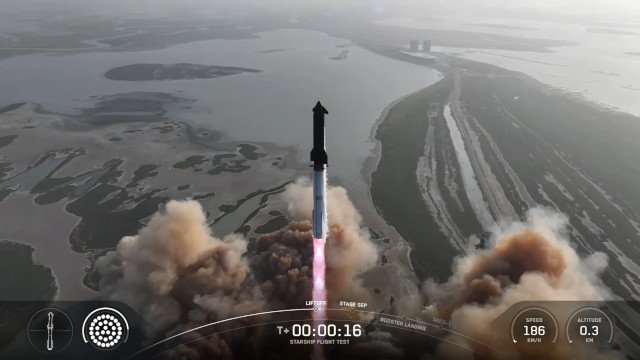
It was the afternoon in the USA when SpaceX conducted a new flight test of its Super Heavy rocket and Starship prototypes, launched from its base in Boca Chica, Texas. This is the 9th test involving the entire system of Elon Musk’s company, which is supposed to revolutionize space travel with an unprecedented transport capacity and being totally reusable. They are advanced prototypes with the Super Heavy identified as Booster 14, on its second flight in the first reuse of a Super Heavy, and the Starship Block 2 identified as Starship 35 or Ship35 or simply S35.
Starship 35 was the third in the Block 2 version, larger than the first version because the liquid methane and oxygen tanks are larger. The 8th test conducted on March 6, 2025, was a failure for Starship due to problems with the Starship 34 prototype. The second failed test of the Block 2 version had marked a step back in SpaceX’s roadmap.
For the 9th test, SpaceX attempted to reuse a Super Heavy for the first time. It was the prototype called Booster 14 that was used for the 7th test. 29 of the 33 engines were the ones already used, another sign that the development of the Super Heavy seems decidedly more advanced than the Starship’s development. From the beginning, a capture attempt from the structure called Mechazilla was not planned for this test. Instead, SpaceX conducted some landing maneuver experiments without the central engines’ burn until splashdown in the Gulf of Mexico.
The 9th test offered few positive results. Starship 35 separated from Super Heavy 14, but subsequent maneuvers showed various problems. There was a loss of telemetry data immediately after the Super Heavy began its descent maneuvers. Above all, there was a loss of attitude by Starship 15 after about half an hour.
The problem with the Super Heavy is the minor one because it was the first attempt to reuse a prototype and the Booster 14 was pushed to undergo extreme stresses to evaluate its resistance. There was the hope of obtaining a greater amount of telemetry data, but at least SpaceX engineers started having an idea of what the resistance limits of this launcher.
The problems with Starship are by far the most worrying for SpaceX. Starship 35 managed to reach orbit, but once again, there seems to have been a leak in a tank that caused the end of the mission. The prototype lost its attitude, and consequently, it was impossible to attempt a controlled reentry. The SpaceX team still managed to splash down Starship 35 in the Indian Ocean, but with a crash that didn’t provide useful information about the landing possibilities of the Block 2 version.
The problems with Starship prevented for the third time the attempt to deploy dummy Starlink satellites into orbit. This increases the delays in the development of Starship. Despite these results, Elon Musk has declared himself optimistic and intends to accelerate the pace of tests to conduct one every 3 or 4 weeks. There seems to be a lot of work for SpaceX, so that might not be possible.
