
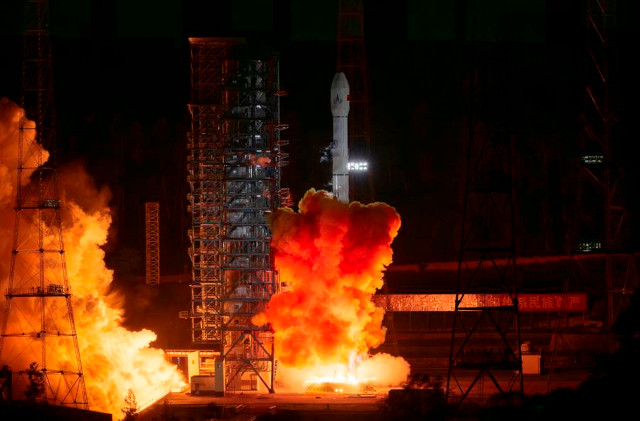
A few hours ago, the Tianwen-2 mission was successfully launched. A Long March 3B rocket blasted off from the Xichang Satellite Launch Center, and after about 18 minutes, the space probe separated from the rocket’s last stage to begin its journey towards the asteroid 469219 Kamoʻoalewa. The goal is to collect samples from its surface to bring back to Earth and then resume its journey in space towards the comet 311P/PanSTARRS.
The asteroid 469219 Kamoʻoalewa, initially cataloged as 2016HO3, is considered an Earth quasi-satellite due to its particular orbit, which is around the Sun but is close to the Earth’s, a situation that has existed for over a century and, according to calculation,s will remain so for a long time to come. It could be a “fossil” dating back to the early phase of the history of the solar system, and in this case, it could offer more information on the birth of the planets. Another theory is that it’s a piece of the Moon that was ejected after another asteroid’s impact.
Despite its relative proximity to Earth, the Tianwen-2 space probe will reach the asteroid Kamoʻoalewa only in June of next year. Asteroid samples have already been returned to Earth by NASA’s OSIRIS-REx and JAXA’s Hayabusa 2 space probes. However, Tianwen-2 will be the first to use a tether system to attach itself to Kamoʻoalewa during sample collection operations.
The Tianwen-2 space probe also carries a small orbiter and a small lander that will separate from the main vehicle to conduct additional observations and surveys in the orbit of the asteroid Kamoʻoalewa. This will provide additional useful information during sample collection operations.
Bringing samples of the asteroid Kamoʻoalewa back to Earth is the primary goal of the Tianwen-2 mission. However, several scientific instruments on board the space probe will be used to collect images and other information about Kamoʻoalewa. The first analyses of the dust ejected during the collection operations will be conducted on site by a dedicated instrument.
If all goes well, at the end of 2027, after returning its cargo to Earth, the Tianwen-2 space probe will set off on its new mission to the comet 311P/PanSTARRS, which it should reach after a journey of about six years since it’s located in the asteroid belt between Mars and Jupiter. Actually, this object can be said to be an asteroid that behaves like a comet, even showing six dust tails. This seems to be due to the fact that the materials present on the surface of 311P/PanSTARRS tend to be ejected due to its rotation speed and the solar wind’s action.
Chinese authorities have declared success for the launch of the Tianwen-2 space probe, which is now on its way to the asteroid Kamoʻoalewa. This is another mission that is part of China’s ambitious space program, which includes both robotic and crewed missions.
