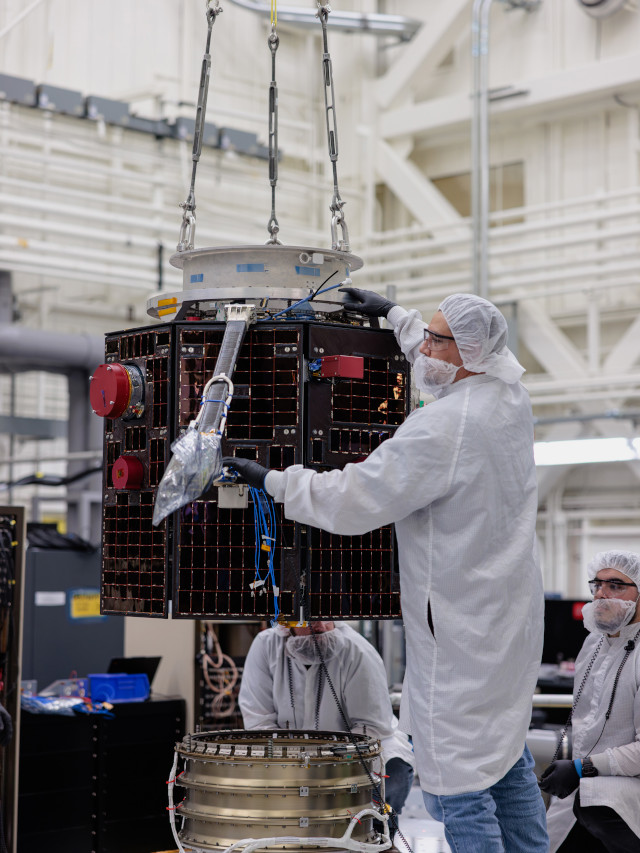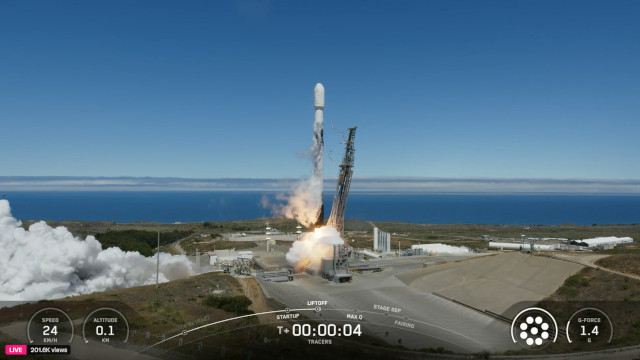
A few hours ago, NASA’s two TRACERS satellites were launched atop a SpaceX Falcon 9 rocket from the Vandenberg Air Force Base. After about an hour and 40 minutes, they successfully separated from the rocket’s last stage to begin the maneuvers that will place them in a Sun-synchronous orbit at an altitude of 600 kilometers.
The two TRACERS (Tandem Reconnection and Cusp Electrodynamics Reconnaissance Satellites) twin satellites join other space missions aimed at studying the Sun and its interactions with the Earth. The PUNCH mission was launched on March 12, and on March 15, the three CubeSat-class nanosatellites of the EZIE (Electrojet Zeeman Imaging Explorer) mission were launched. EZIE’s goal is to study changes in electrical currents moving through the upper layers of Earth’s atmosphere in the polar regions.
The TRACERS mission will focus on magnetic reconnection, and it’s not NASA’s first mission with this goal. A little over a decade ago, the MMS quartet of spacecraft began this type of work and continues to pursue it well beyond the two-year mark of its primary mission.
The two TRACERS satellites will measure magnetic reconnection 3,000 times a year. Comparing the data collected by the instruments onboard the two satellites will be invaluable in helping scientists observe the rate at which this process is changing and evolving.
The orbits of the TRACERS satellites are significantly different from those of the MMS spacecraft, and this will help complement the observations obtained by the two missions. These observations will also be combined with those from other missions to provide information on various aspects of the flow of solar energy through the Earth’s magnetosphere and atmosphere.
Mission control has successfully established communications with the TRACERS satellites. After the commissioning period, the TRACERS mission will contribute to improving our understanding of solar activity and its influence on Earth, particularly the process of magnetic reconnection. Their primary mission will last one year, with the possibility of extension.