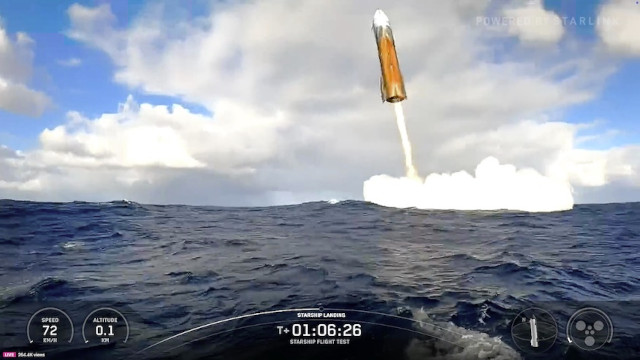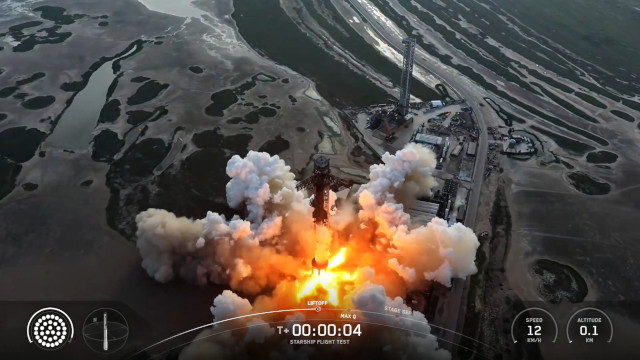
It was the afternoon in the USA when SpaceX conducted a new flight test of its Super Heavy rocket and Starship prototypes, launched from its base in Boca Chica, Texas. This is the 10th test involving the entire system of Elon Musk’s company, which is supposed to revolutionize space travel with an unprecedented transport capacity and being totally reusable. They are advanced prototypes with the Super Heavy identified as Booster 16 and the Starship Block 2 identified as Starship 37 or Ship37 or simply S37.
After the negative results for Starship in its latest flight tests, there was considerable tension and curiosity to see if the SpaceX team would be able to conduct a successful test. The 9th test conducted on May 27 left many doubts, and a lot of work was done to improve the Starship. The importance of this 10th test was stressed by Elon Musk’s presence on the live broadcast.
Super Heavy Booster 16 launched normally and conducted a test that, from the outset, had the goal of splashing down in the Gulf of Mexico at a steeper angle than normal to test it under high stress. During Starship separation, one of the engines shut down earlier than scheduled, but the rest of the rocket test went smoothly.
The most anticipated test was that of Starship Block 2. At last, this version successfully flew. Eight dummy Starlink satellites were deployed, an important goal to understand if the system was working properly. The ignition of a Raptor engine in space was also successful, another important goal of this test.
Starship 37’s reentry into the atmosphere was intended to stress the structure. The fins were damaged during reentry, but this was anticipated. Despite the damage, this prototype splashed down in the Indian Ocean.
After many problems with the previous tests, this success puts SpaceX back in the running to have a rocket and spacecraft system ready for Moon missions. The problem is that the company has accumulated various delays, so it seems unlikely that Super Heavy and Starship will be able to conduct a Moon mission in 2027. For now, it remains to be seen how long it will take before they are capable of carrying out a normal satellite launch mission.