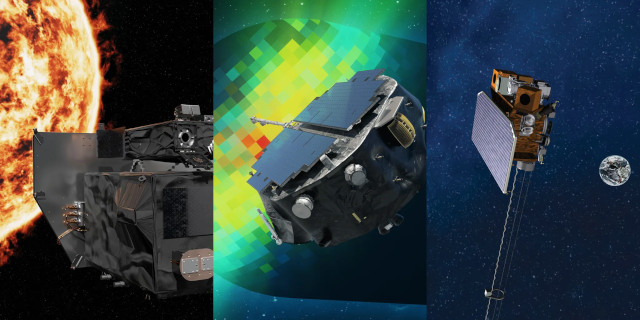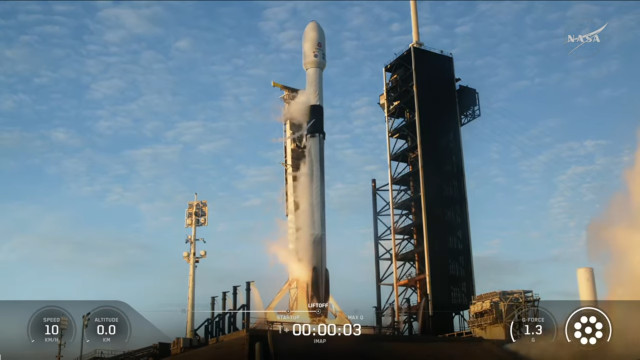
A little while ago, three space probes were launched atop a Falcon 9 rocket from the Kennedy Space Center. After approximately one hour and 23 minutes, they successfully separated from the rocket’s final stage within about 13 minutes and set off on a course that will take them to the area known as L1 (Lagrange 1), about 1.5 million kilometers from Earth, where they will begin their scientific work studying various aspects of space weather.
Space weather is a scientific branch that studies the activity generated by the Sun and its consequences within the solar system, particularly on Earth. Solar emissions extend their influence into the enormous bubble surrounding the solar system, known as the heliosphere. The solar wind continually strikes Earth, and in the event of a solar flare, the emissions can be truly violent: the auroras are spectacular, but the consequences are potentially dangerous. Even under normal conditions, astronauts in deep space can be exposed to dangerous radiation. Especially these potential dangers have led to increasingly sophisticated studies of space weather over time.
NASA’s IMAP (Interstellar Mapping and Acceleration Probe) space probe aims to study how the Sun’s energy and particles interact with the heliosphere. This mission will study cosmic radiation in particular, which can impact Earth and its inhabitants as well as spacecraft. Among other things, IMAP will map the edges of the heliosphere, helping to understand how this colossal bubble interacts with emissions from the cosmic neighborhood. A secondary goal of the mission is to analyze dust likely arriving from interstellar space to better understand its nature.
NASA’s Carruthers Geocorona Observatory is a small space probe that will observe the outermost layers of Earth’s atmosphere, called the exosphere. It will capture images of the faint ultraviolet glows in the region called the geocorona to better understand the impact of space weather on Earth. Conditions in that area are constantly changing and can affect satellites in orbit as well as power grids on the ground.
NOAA’s SWFO-L1 (Space Weather Follow On-Lagrange 1) space probe will monitor the Sun and the near-Earth environment to detect space weather activity. The goal is to detect any potential hazards arising from peaks in activity that could damage satellites in orbit and infrastructure on Earth.
The space probes have begun their long journey. It will take some months to reach the L1 area. The probes’ instruments will begin their test phase in January 2026. If all goes well, scientific data will start arriving next year, increasing our knowledge of various aspects of the heliosphere.