An article published in the journal “Monthly Notices of the Royal Astronomical Society” reports the discovery of three odd radio circles, including a pair cataloged as RAD J131346.9+500320. The discovery was made by examining data collected during the LOFAR Two-Metre Sky Survey (LoTSS) thanks to the collaboration of citizen scientists in the RAD@home program. A team of researchers examined these objects, and in particular, what appears to be a pair of intersecting rings, concluding that they’re the most distant discovered so far and that their emissions are the most powerful detected from these still poorly-known cosmic objects.
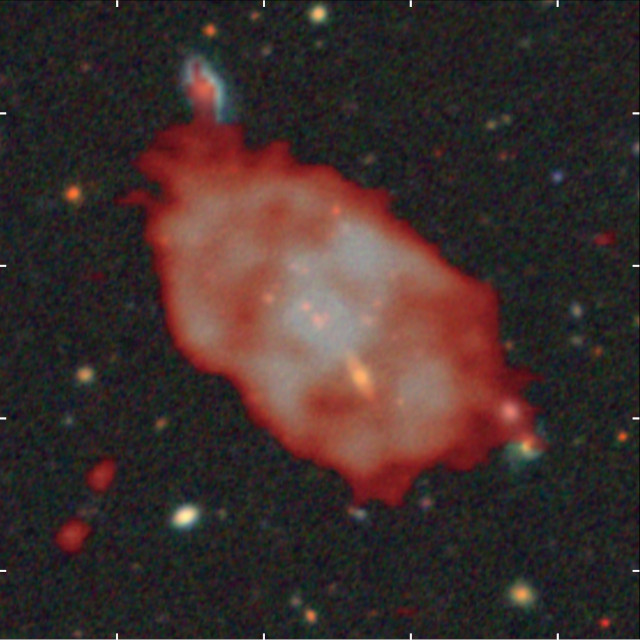
The top image (RAD@home Astronomy Collaboratory (India). (CC BY 4.0)) shows an optical-frequency image from the Legacy Surveys overlaid with radio emissions from the LoTSS survey, revealing the area of the odd radio circle RAD J131346.9+500320.
Odd radio circles are objects that are still poorly understood because only a few of them have been detected, starting in 2019. These rings can extend much further than a galaxy and shine only at radio frequencies. Shock waves generated by the merger of supermassive black holes were proposed as a possible cause of odd radio circles. Now this new study suggests that they’re linked to the outflow of powerful winds from radio galaxies, galaxies characterized by very strong radio emissions.
The LOFAR (Low Frequency Array) radio telescope is based on a network of antennas spread across Europe. Among other things, LOFAR was used for an astronomical survey aimed at cataloging over 10 million radio sources. These are mainly galaxies undergoing star formation, with a significant number of active galactic nuclei. However, this survey also allowed the discovery of objects such as the odd radio circles studied in this study, thanks to the help of citizen scientists in the RAD@home program.
The pair cataloged as RAD J131346.9+500320 is estimated to be around 7 billion light-years from Earth, and each ring spans nearly a million light-years. The second object at the center of this study was cataloged as RAD J122622.6+640622 and spans nearly three million light-years. The third object was cataloged as RAD J142004.0+621715 and spans approximately 1.4 million light-years.
These new odd radio circles have in common the fact that they’re located within large galaxy clusters. The researchers propose that at least in the case of the pair RAD J131346.9+500320, powerful intergalactic winds play a role in generating these objects. In their study, they compared this to the solar wind compressing Earth’s magnetosphere, theorizing that what they termed a galactic superwind could encounter a radio jet or plasma, resulting in the creation of a ring shape.
The researchers examined the characteristics of the environments in which these odd radio circles were found and the various possible mechanisms underlying their origin. They also recognized the importance of the help that ordinary people can provide through projects in which anyone can contribute.
The discovery of three new odd radio circles suggests that these aren’t isolated phenomena but rather a family of exotic structures that only the instruments available today can detect. This means that in the coming years, advances in radio astronomy could allow to find more of them and study them better, for example, with the SKA radio telescope, which might enter service in 2027.
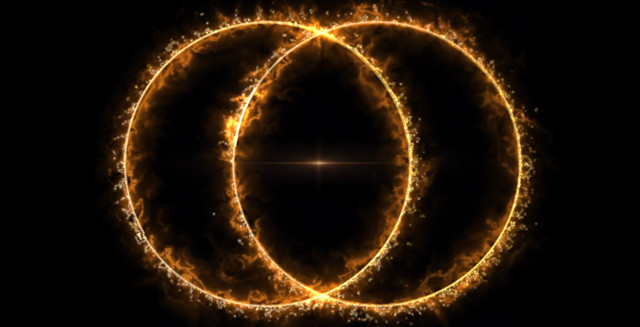
The bottom image (RAD@home Astronomy Collaboratory (India). (CC BY 4.0)) shows a screenshot from the animation reproducing the odd radio circle RAD J131346.9+500320.