
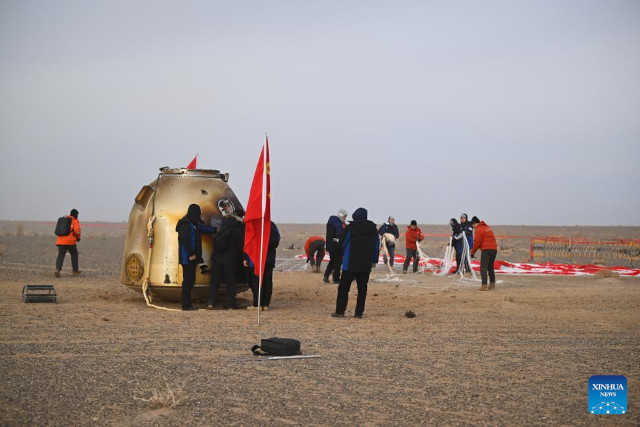
A few hours ago, the Shenzhou 20 spacecraft landed after spending 270 days docked at the Chinese Tiangong space station, where it arrived on April 24, 2025, carrying three taikonauts: Chen Dong, Chen Zhongrui, and Wang Jie. The Shenzhou 20 departed the station about nine hours earlier and landed at a site called Dongfeng in China’s Inner Mongolia Autonomous Region. The three taikonauts returned to Earth on November 14, 2025, aboard the Shenzhou 21 spacecraft because the Shenzhou 20 suffered small fractures to a window following the impact of what was likely space debris and was deemed unsafe for human transport. Despite this, the preliminary inspection showed that the Shenzhou 20 is generally in good condition.
The Shenzhou 20 taikonauts were scheduled to return to Earth in early November 2025, but their return was postponed following the discovery of a suspected impact from a small piece of space debris. At speeds of thousands of kilometers per hour, even a tiny object can cause significant damage, so tests were needed to assess the potential damage.
The examination of the Shenzhou 20 spacecraft revealed window fractures that were tiny but enough to deem it unsafe for crewed transport. For this reason, it was decided to leave it in orbit for experiments, pending its return without a crew. On December 9, 2025, during a spacewalk, the taikonauts took close-up photos of the damaged window to allow for further assessment of the damage.
To return the taikonauts of the Shenzhou 20 mission, it was decided to use the Shenzhou 21 spacecraft, which reached the Tiangong space station on October 31, 2025. On November 25, 2025, the Shenzhou 22 spacecraft reached the Tiangong space station without a crew and will be used by the taikonauts aboard the Tiangong to return to Earth. A system for treating the window damage was sent into space and installed on the Shenzhou 20.
The Shenzhou 20 spacecraft capsule landed intact. The preliminary inspection conducted at the Dongfeng site showed that it was overall in a good state, and the items inside were in good condition. Essentially, the damaged window still withstood the stresses that the Shenzhou 20 had to endure during atmospheric reentry. The forced extension of its mission also showed that it’s capable of withstanding the conditions existing in space for nine months.
In the end, all the emergency procedures proved the great caution with which astronaut spaceflight is managed and the ability of Chinese engineers and technicians to handle its various phases. Now the Shenzhou 20 spacecraft will undergo a thorough inspection to examine the damage to the window in detail and assess how much the applied “patch” contributed to its successful return to Earth.
