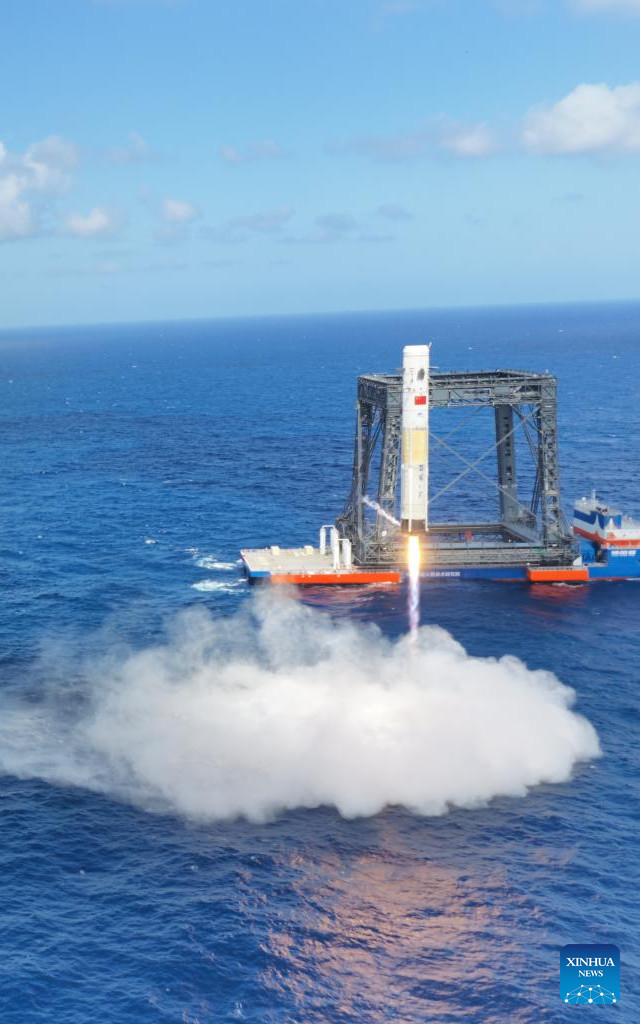
Yesterday, the Chinese Menghzou spacecraft, launched on the Long March 10 rocket’s first stage from the Wenchang launch site, completed a suborbital flight test. The rocket conducted its own test, lasting nearly 8 minutes, with a controlled splashdown, as part of the development of a reusable launch system. At the end of the test, the Menghzou splashed down as well, but in its case, it was also recovered, as the capsule is designed to carry taikonauts and is also reusable. These were important tests because their success represents a step forward toward Chinese crewed Moon missions.
China has a national crewed space station and has sent landers and rovers to the Moon, but the ambitions for the national space program include sending taikonauts, as the Chinese call their astronauts, to the Moon within the next decade.
SpaceX has proved over the past decade that the ability to reuse the first stage of a rocket offers significant advantages. Cost is certainly a major factor, but the recovery and rapid refurbishment of a first stage allows for multiple launches in a short time. China is also developing at least partially reusable rockets, and yesterday’s test included testing the first stage of the Long March 10, the super-heavy launcher that is designed be used for crewed Moon missions.
Regarding the spacecraft, the Shenzhou, currently used to transport taikonauts to the Tiangong space station and return them to Earth, is suitable for orbital missions. For this reason, the larger Menghzou, designed for crewed Moon missions, is under development. It’s designed to carry up to six taikonauts and will be partially reusable in a modular design that will allow it to be adapted to the needs of different space missions.
In yesterday’s test, the Menghzou spacecraft was uncrewed, and the purpose was to test the emergency abort system, which activates in the event of a problem endangering the crew. The problem was simulated at the point of maximum dynamic pressure (MaxQ), the most critical, and it successfully splashed down.
In the case of the Long March 10 rocket’s first stage, this was the first test of the controlled landing system, so there was no recovery, but rather a controlled splashdown. The maneuvers were conducted successfully, but the test still ended with the sinking of the first stage. When a real landing is attempted, it will be on a sea platform, which was located approximately 200 meters away, to obtain data on the synchronization with the landing maneuvers.
The information provided is that approved by the Chinese authorities. The test was deemed a success for both the Long March 10 rocket and the Menghzou spacecraft, but it will still be necessary to analyze all the collected data and examine the status of the Menghzou to reach a definitive assessment. If the results are satisfactory, a real landing test of the Long March 10 first stage could be conducted, and the Menghzou could be sent, again uncrewed, to the Tiangong space station to test its docking system.