
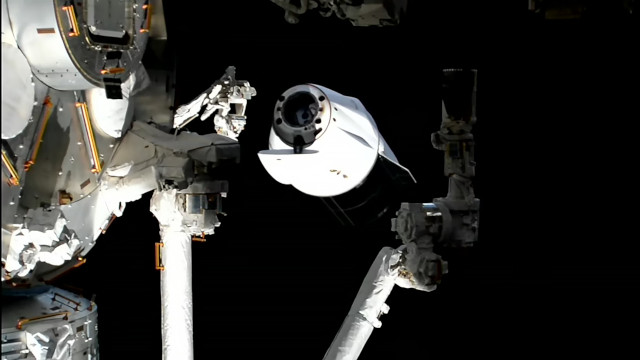
A little while ago, SpaceX’s Dragon spacecraft ended its CRS-33 (Cargo Resupply Service 33) mission for NASA splashing down smoothly off the coast of California. The Dragon left the International Space Station about 12 hours earlier. The Dragon spacecraft had reached the International Space Station on August 25, 2025. For SpaceX, it was the 50th mission to the Station, including the Dragon cargo and Crew Dragon crewed missions.
Shortly after the splashdown, SpaceX’s “MV Shannon” recovery ship went to retrieve the Dragon to transport it to the coast. Last year, after several missions completed in the Atlantic Ocean, it was decided to return to splashdowns in the Pacific. That’s because there were cases where the unpressurized section, which separates during descent into the atmosphere, had fallen onto land and posed a potential hazard. The descent into the Pacific allows the unpressurized section to disintegrate in the ocean. The cargo returned to Earth will be delivered to NASA within 48 hours.
The Dragon spacecraft brought back to Earth a number of payloads that include various scientific experiments and biological samples. Part of the samples is contained in the freezers because they need to be kept at low temperatures. SpaceX is the only American company that has a spacecraft capable of bringing intact cargo back to Earth, so the Dragon missions are really important for NASA. Samples produced during many of the experiments conducted on the International Space Station may require in-depth analyses possible only in specialized laboratories on Earth.
The SpaceDuino experiment aims to test the potential of using Arduino, Raspberry Pi, and other SBC (Single-Board Computer) electronic boards in space. Low costs (at least before the sharp rise in memory prices!) and the existence of highly active and rich ecosystems for the development of their software, often free and open source, make this type of hardware very attractive for potential space applications.
Medical experiments also constitute an important part of those conducted on the International Space Station. Among them, the Dragon brought back samples from the Stellar Stem Cells Mission 2 experiment, part of a program designed to study the effects of microgravity on the human body: in this case, the growth of heart and brain stem cells. The results are important for studying diseases such as ALS and Parkinson’s disease.
The next resupply mission for the Dragon cargo spacecraft could begin in a few months, but no precise timeline has been established yet. With the recent increase in missions that sometimes only stop at the International Space Station, cargo spacecraft mission dates are more subject to change than ever.
Meanwhile, a mission that lasted a total of about six months has concluded, much longer than previous missions, given that Dragon cargo spacecraft typically returned to Earth after just over a month. During the CRS-33 mission, Dragon used its thrusters to adjust the Station’s orbit on several occasions.
