
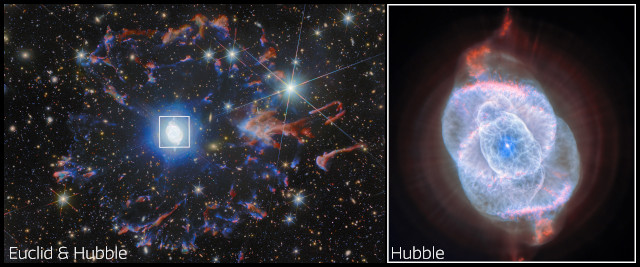
The planetary nebula NGC 6543, also known with the nickname Cat’s Eye, is the protagonist of the Hubble Space Telescope’s photo of the month. However, for this occasion, a juxtaposition was created between an image captured by Hubble and one captured by ESA’s Euclid Space Telescope. These two instruments can both capture wavelengths in the near-infrared and visible light, but Euclid specializes in deep-field surveys. For this reason, it portrayed NGC 6543 as part of a large region of space. The combination of the two telescopes offers greater detail on a planetary nebula that has been studied for over two centuries.
The image (ESA/Hubble & NASA, ESA Euclid/Euclid Consortium/NASA/Q1-2025, J.-C. Cuillandre & E. Bertin (CEA Paris-Saclay), Z. Tsvetanov, CC BY-SA 3.0 IGO license) shows on the left a combination of photos from the Euclid and Hubble space telescopes, with a close-up view from a Hubble photo on the right.
Discovered on February 15, 1786, by astronomer William Herschel, for a long time, NGC 6543 was mistakenly considered planetary in nature, hence its name. Only in 1864 did astronomer William Huggins discover its true nature by analyzing the spectrum of electromagnetic emissions from NGC 6543. The name stuck, but today we know that it represents the final phase of a star’s life, in which it’s undergoing its death throes, ejecting its outer layers.
The Hubble Space Telescope captured details of the various materials surrounding NGC 6543’s progenitor star, which form complex structures. Studying the structures created in planetary nebulae helps us understand the processes at work in those relatively short stages. In this case, some astronomers hypothesized that the Cat’s Eye Nebula may actually have been formed by a binary star, but no evidence has been found to date.
The details collected by the many instruments used over time to study the planetary nebula NGC 6543 in various electromagnetic bands remain invaluable in increasing the chances of finding answers to the remaining questions. In this case, the combination of the Hubble and Euclid Space Telescopes offers a close-up view combined with a view of a wide area of sky.
The importance of using multiple instruments to study an astronomical object can be seen in the case of the planetary nebula NGC 6543 in calculating its distance from Earth. Many methods used in astronomy fail for planetary nebulae, and for this reason, distance estimates are very approximate, with significant differences depending on the method used.
The Hubble Space Telescope was already used to estimate the NGC 6543’s distance by measuring its angular expansion velocity and spectroscopic observations, which yielded a result of approximately 3,300 light-years from Earth. However, observations conducted over the years by ESA’s Gaia spacecraft led to an estimate that places NGC 6543 at approximately 4,300 light-years from Earth.
A planetary nebula has a lifetime of only a few tens of thousands of years, making it short in astronomical terms. In human terms, this provides a very long time to study the final phase of a star’s life. NGC 6543 shows how these objects can offer extraordinary shows and, at the same time, are very interesting from a scientific point of view because the progenitor star has already started ejecting various chemical elements into interstellar space that, in the future, could end up in new star systems, enriching new planets.
