
An article submitted for publication in the journal “Astronomy & Astrophysics” reports the results of an astronomical study that used a hybrid technique to examine the Vela Supercluster. A team of researchers combined redshifts with the distances and peculiar velocities of galaxies within the Vela Supercluster to obtain a complete portrait of it, a result that was previously impossible due to its location, hidden by the Milky Way’s so-called zone of avoidance.
Key information was obtained using the SALT optical telescope and the MeerKAT radio telescope, both in South Africa. Given the importance of this nation in this research, the authors used the nickname Vela-Banzi, adding a term in Xhosa, a Bantu language, which means “revealing widely.”
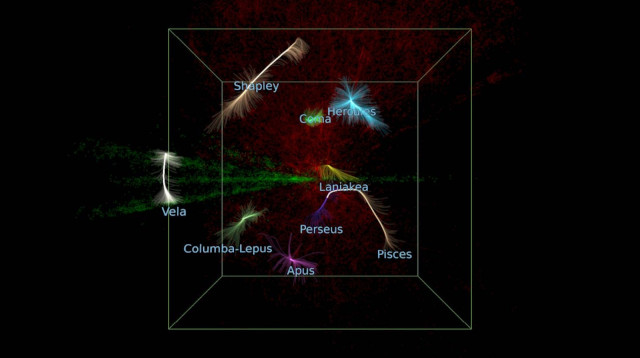
The image (Courtesy Dr. Jérôme Léca, RSA Cosmos, St. Etienne, France. All rights reserved) shows a 3D map of the local universe with the various galaxy superclusters. On the left is the Vela Supercluster.
About 800 million light-years from Earth, the Vela Supercluster could be one of the most colossal structures in the universe, as it may include 13 clusters and 19 groups of galaxies. The problem is that, relative to Earth, it lies behind the dense disk of the Milky Way, a region known as the Zone of Avoidance. For this reason, its discovery was only reported in late 2016 in a paper that described it with the Latin expression “Terra incognita” (unknown land).
It took considerable effort to develop a portrait of the Vela Supercluster, and data collected from astronomical surveys conducted with various instruments were used. The MeerKAT radio telescope is one of the precursors to the SKA, the next-generation radio telescope, and its use provided key information for this study. MeerKAT’s exceptional sensitivity allowed for improved detections of wavelengths that are among the few that pass through the zone of avoidance.
Even with cutting-edge instruments, the researchers had to use an innovative hybrid technique to reconstruct a portrait of the Vela Supercluster. Combining the distances and peculiar velocities of 65,518 galaxies with the redshifts of 8,283 new galaxies observed near the southern galactic plane allowed them to reconstruct the mass distribution, including dark matter, across a vast area of space where visibility is very limited.
The observations conducted in South Africa were crucial to this study, and for this reason, the authors used the nickname Vela-Banzi for the supercluster, adding a term in Xhosa, a Bantu language, which means “revealing widely.” This colossal structure was shown to extend approximately 300 million light-years across, potentially making it the largest known.
This study is important for different reasons beyond the reconstruction of the Vela-Banzi Supercluster. It demonstrates the value of a hybrid technique that combines different types of observations to reconstruct structures that are difficult to observe directly. Information on a colossal structure such as a galaxy supercluster offers new possibilities to test cosmological models such as those about dark matter and dark energy, and more.
