
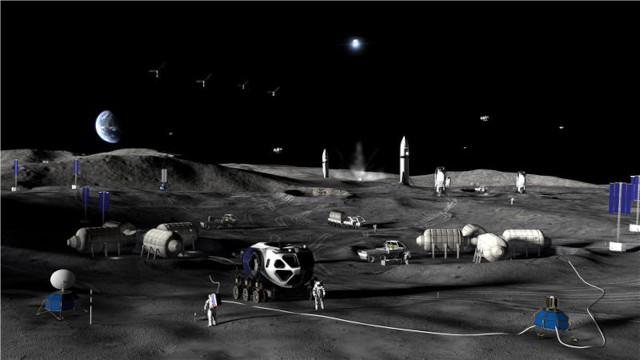
Yesterday, NASA held its Ignition event, featuring a series of announcements regarding its space program. Announcements were expected from new Administrator Jared Isaacman and other agency managers in connection with the Artemis program, to clarify the agency’s intentions regarding the return of astronauts to the Moon. From this perspective, the intention that was announced is to accelerate the pace of missions, also in order to build a permanent base on the Moon. In this new vision, the Lunar Gateway project might be abandoned, although officially, it remains relevant in the long term.
The program for missions to Mars was also part of the event. In this case, the Space Reactor-1 Freedom (SR-1 Freedom) mission was introduced, to be conducted using a spacecraft that will use nuclear electric propulsion, scheduled for launch in December 2028. A fleet of Skyfall helicopters is programmed to be on board, intended to continue exploration of the red planet.
The delays that the Artemis II mission is accumulating due to the problems encountered with the SLS are raising doubts about this launch system. For some time now, announcements have been increasingly open to a gradual transition to at least another rocket as soon as possible. Blue Origin’s New Glenn has already completed two official launches, while SpaceX’s Super Heavy/Starship combination is still in development. On the other hand, the enormous costs of the SLS, which has been the subject of controversy for years, would prevent the Artemis program from progressing much further.
Rocket aside, the new plan calls for the Artemis III mission to be conducted in 2027, but “only” to test in low Earth orbit various systems and operational capabilities that will be necessary for subsequent missions. Astronauts will return to the Moon on the Artemis IV mission using a lander yet to be chosen. The partners mentioned include not only private companies but also other space agencies such as the Italian ASI and the Canadian CSA.
The plan from the Artemis V mission onward is to conduct a Moon landing every six months using privately produced, reusable hardware to enable frequent missions. This is a bit vague, but SLS is an “old-school” non-reusable launch system, whereas New Glenn and Super Heavy/Starship are designed to be reusable. The huge cost differences between SLS and private rockets are due to this reason and the differences between a project overseen by the US Congress and projects decided by the company owners.
NASA’s announcement mentions a pause in the Lunar Gateway project in its current form to focus on building a permanent Moon base. The commitment to activities in low Earth orbit remains even after the International Space Station is decommissioned. This is the official schedule, and it remains to be seen whether the Lunar Gateway will actually be built.
The Artemis program is central to the Ignition event, but NASA isn’t neglecting Mars. The Space Reactor-1 Freedom (SR-1 Freedom) mission, to be conducted using a nuclear-electric spacecraft, is expected to represent a step forward in the development of advanced technologies needed to shorten the duration of journeys to Mars. The Ingenuity helicopter was the first to be tested on Mars, and the experience led to the Skyfall helicopter project for larger-area exploration. The idea is to find areas suitable for human landings and map the presence of water ice that could be used by them.
It’s been over a decade since the then Obama administration supported the initial plans to send astronauts to Mars. After the end of the Cold War, the incentive to go to the Moon waned, and only recently has the Chinese space program sparked a new rivalry, joined by commercial interests from various companies. At this point, it remains to be seen who, between the Americans and the Chinese, will win the new race to the Moon and how the space programs will progress.
