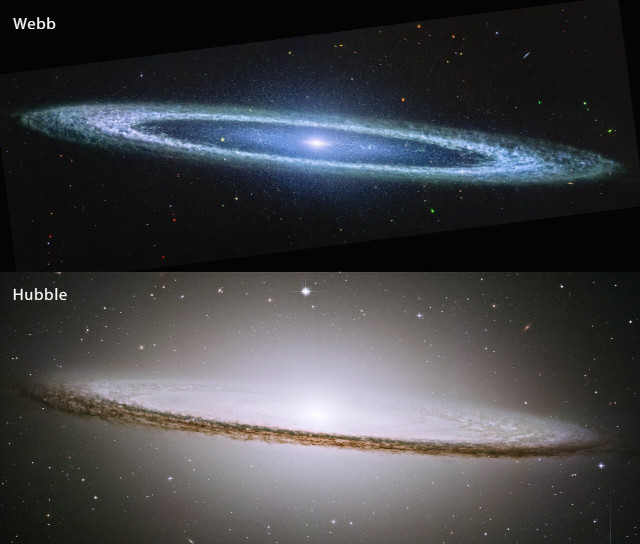
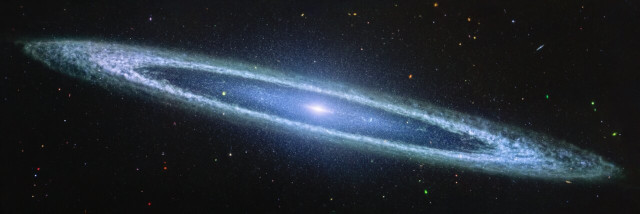
 A new image (NASA, ESA, CSA, STScI) captured by the James Webb Space Telescope depicts the Sombrero Galaxy in infrared. The MIRI (Mid-Infrared Instrument) instrument offers details invisible to other telescopes, creating a portrait different from what astronomers are used to. The nucleus is very bright at visible light frequencies while in infrared a smooth inner disk is revealed. The outer disk is “clumpy” and this allows to understand the distribution of dust inside it, an important result to get an idea of the ongoing star formation processes.
The Sombrero Galaxy, also known by catalog designations among which M104 and NGC 4594 are the most common, owes its nickname to its particular shape, which according to a study published in “The Astrophysical Journal” in February 2020 could be the result of one or more galaxy mergers that occurred in the distant past.
The supermassive black hole at the center of the Sombrero Galaxy is extreme even by the standards of these objects, with a mass that was estimated around nine billion times the Sun’s. It powers an active galactic nucleus that is, however, rather docile, and for this reason, it’s classified as a low-luminosity active galactic nucleus. In short, it’s an active galactic nucleus, but not too active.
Astronomers are also intrigued by the low rate of star formation detected in the Sombrero Galaxy, estimated at less than half the Milky Way’s. About 2,000 globular clusters have been detected within it, groups of thousands of old stars. This large number of globular clusters is associated with the large central bulge of the galaxy.
To try to get answers, astronomers have been observing the Sombrero Galaxy with every instrument available since it was discovered in 1781 by the French astronomer Pierre Méchain. The development of infrared astronomy has added a lot of information about it, and the James Webb Space Telescope has confirmed its extraordinary performance with new images in the mid-infrared captured by the MIRI instrument. In that band, a uniform inner disk can be seen, whereas in visible light the Hubble Space Telescope sees only the very bright galactic nucleus. The difference can be seen in the bottom image (NASA, ESA, CSA, STScI, Hubble Heritage Team (STScI/AURA)).
Interstellar dust is a kind of tiny building block from which larger objects start to be built, so astronomers are very interested in its distribution. These infrared observations of the Sombrero Galaxy show that the dust in its outer disk isn’t as uniformly distributed as it seemed in images captured by NASA’s Spitzer Space Telescope, showing for the first time how it’s clumped.
MIRI’s detections also indicate the presence of polycyclic aromatic hydrocarbons (PAHs), molecules common in space that can indicate regions of star formation. Protostars and newborn stars still surrounded by a cocoon of gas and dust might be invisible. Infrared frequencies are among the few that are not blocked by dust, making instruments sensitive in this electromagnetic band even more important.
Observations of the Sombrero Galaxy conducted with the James Webb Space Telescope confirm the importance of obtaining quality images in the infrared. Combining observations in different electromagnetic bands offers more information, in this case, on the Sombrero Galaxy.