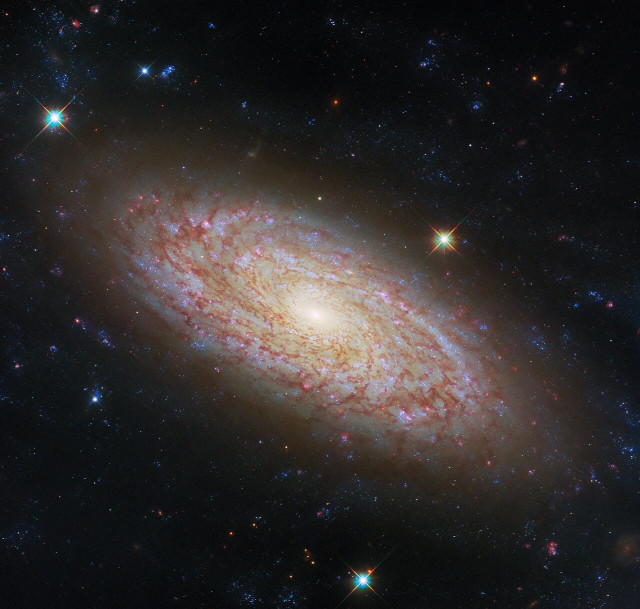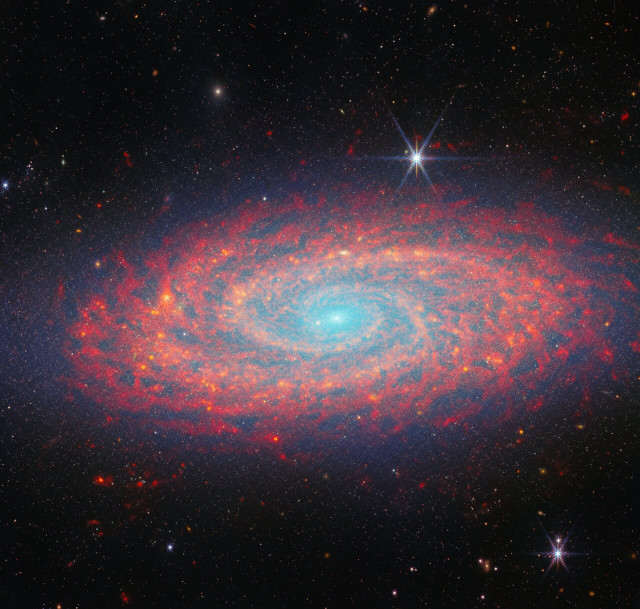
ESA has published an image captured by the James Webb Space Telescope that portrays the galaxy NGC 2090 in the near and mid-infrared thanks to the combination of the MIRI (Mid-InfraRed Instrument) and NIRCam (Near-InfraRed Camera) instruments. This allowed to obtain an unprecedented amount of detail on this galaxy’s two spiral arms. For ESA, which participates in various astronomical missions, NGC 2090 is at the center of the scene these days because the choice for the Webb image of the month follows by a few days the choice for the Hubble Space Telescope image of the week, captured using various WFC3 (Wide Field Camera 3) instrument’s filters in the visible frequencies and an ultraviolet filter.
Known for almost two centuries, the galaxy NGC 2090 has been the subject of many studies. Astronomers consider it important also in measuring the speed of the universe expansion, technically called the Hubble constant, thanks to the presence within it of stars called Cepheids, used in one of the techniques for that type of measurement. For this reason, it’s important to know the precise distance of a galaxy, and according to the latest measurements, NGC 2090 is about 40 million light-years from Earth, a little further away than previously estimated.
Observations conducted with the James Webb Space Telescope show extraordinary details of the galaxy NGC 2090’s spiral arms. NIRCam also detected starlight in the central area of the galaxy, which is visible in blue in Webb’s image.
Star formation is remarkable in some star clusters, and for this reason, it’s among the processes taking place in the galaxy NGC 2090 at the center of astronomers’ interest. The images captured by the Hubble Space Telescope show a galaxy with a dusty patchy disk and flaky arms or are not even visible. For this reason, it has been defined as a flocculent spiral galaxy.
The power and sensitivity of the James Webb Space Telescope represent the state of the art in infrared astronomy. However, the Hubble Space Telescope continues to be very useful also in observations at the frequencies of visible and ultraviolet light. The combination of observations in different electromagnetic bands can provide a more complete picture of the processes at work in the galaxy NGC 2090. More than ever, there are at the same time breathtaking images and useful information for scientific research.