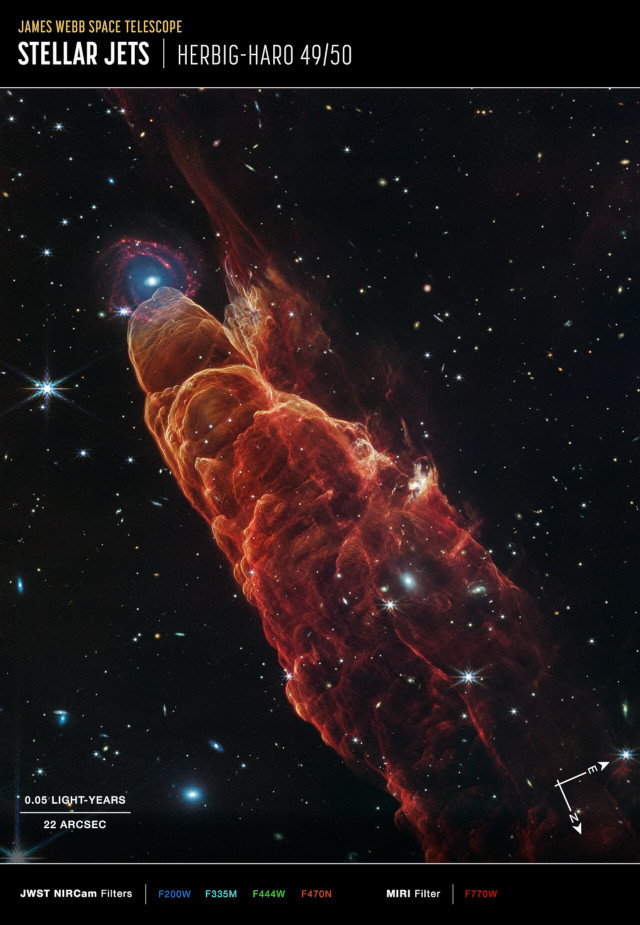
An image captured by the James Webb Space Telescope (NASA, ESA, CSA, STScI) shows Herbig-Haro 49/50, or simply HH 49/50, a type of nebula associated with star formation. The Near-Infrared Camera (NIRCam) and Mid-Infrared Instrument (MIRI) instruments were used in combination to observe infrared details of the outflows whose shape led to the object being nicknamed the Cosmic Tornado. For years, astronomers have wondered what the object they could barely see in images obtained with other instruments at the “tip of the tornado” was, and Webb helped them realize that it’s a spiral galaxy that is far more distant.
HH 49/50 is about 630 light-years from Earth, practically in the cosmic neighborhood from an astronomical point of view. It’s part of the Chameleon Cloud, classified as a dark molecular cloud because the large amount of gas and dust it contains blocks almost all electromagnetic emissions from inside it.
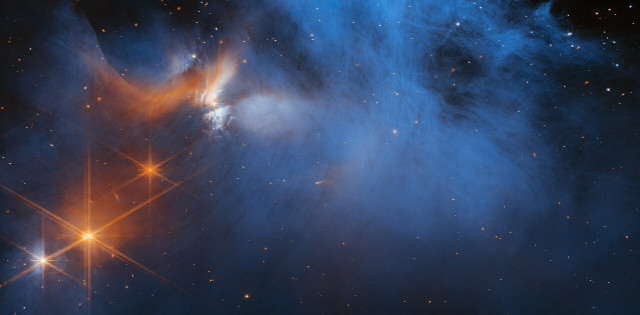
Chamaeleon I is one of the clouds that make up the Chameleon Cloud complex, and many stars of similar mass to the Sun are being born within it. The James Webb Space Telescope was used to detect icy molecules within it in a study published in the journal “Nature Astronomy” in January 2023. Some planetary systems forming within it are among the ones examined in a large study reported in three articles published in the journal “Astronomy & Astrophysics” in March 2024.
Herbig-Haro objects are interesting to astronomers because they represent a short phase in astronomical terms, no more than a few hundred thousand years, in the evolution of a star. While they are still forming, stars are very active and can emit jets of gas that is ionized by shock waves generated by collisions with other gas that is traveling more slowly. This process forms the lobes typical of Herbig-Haro objects. The gas emissions are erratic, so they change over time with noticeable differences even after a few years.
In 2006, NASA’s Spitzer Space Telescope was used to study HH 49/50 and discovered the tornado-like shape that gave it its nickname. Outflows of gas are characteristic of Herbig-Haro objects but each one has a different shape and astronomers wondered what created the spiral in HH 49/50. Hypotheses include magnetic fields flowing through the region and shock waves that could have created instabilities when they hit surrounding materials.
These new observations with the James Webb Space Telescope allowed them to map the locations of hydrogen, carbon dioxide, and dust grains charged by the violently expanding protostellar jets. This will help them better understand the processes at work, the properties of the material jets, and how they affect the surrounding materials.
The observations conducted in 2006 with the Spitzer Space Telescope raised suspicions that the object at the “tip of the tornado” was a star and that it could be close to HH 49/50. However, Webb provided much more detail and astronomers realized that it’s actually a spiral galaxy that is far more distant. Webb’s power shows this galaxy’s nucleus in blue and its spiral arms in red. Its position is a coincidence we’ll be able to see for some time, but in the next millennia, the edge of HH 49/50 will eventually cover it.
Despite the details captured by the James Webb Space Telescope, HH 49/50 still holds some mystery. The outflows don’t seem to come from the same direction and the reason isn’t clear: it could be the superposition of different outflows or a consequence of the fragmentation of the main outflow. Studies will continue to obtain new information on this Herbig-Haro object and in general on this phase of the star formation processes.