
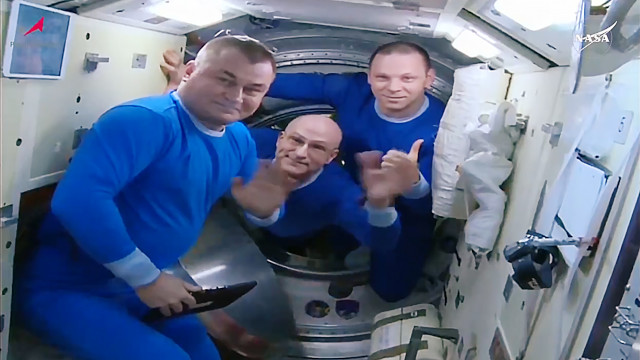
A few hours ago, cosmonauts Alexey Ovchinin and Ivan Vagner and astronaut Don Pettit returned to Earth on the Soyuz MS-26 spacecraft, which landed in Kazakhstan. They had reached the International Space Station on September 11, 2024, as part of a crew rotation that has returned to normal after some time.
During their time on the International Space Station as part of Expedition 72, the three crew members performed routine maintenance and many scientific experiments. It was the last part of Expedition 72, so there weren’t many out of the ordinary events. On March 28, the Cygnus cargo spacecraft S.S. Richard “Dick” Scobee departed the Station and began a series of maneuvers that led to its disintegration in the Earth’s atmosphere after a couple of days.
On Friday, April 18, Alexey Ovchinin officially handed over command of the International Space Station to Japanese astronaut Takuya Onishi. The launch of the Soyuz MS-26 spacecraft marked the start of Expedition 73.
In recent years, there have been somewhat unusual crew rotations involving tourist trips and year-long missions. Now, the rotation is back to normal, at least for now, if we can call that normal when it comes to space missions. Rotations managed by the space agency Roscosmos with Soyuz spacecraft and rotations managed by NASA and SpaceX with Crew Dragon spacecraft ensure a stable presence on the International Space Station.
In the short term, the next rotations have been defined, but it remains to be seen what the various nations’ plans are for the coming years. Russia continues to pursue its plans to build a national space station even as Roscosmos continues to have problems. At this point, we will also have to see what plans the new administration will actually impose on NASA regarding the entire American space program. The next few years may mark new conquests, but the involvement of other private companies doesn’t ensure new successes. This is a situation that will only be clarified over time.
