
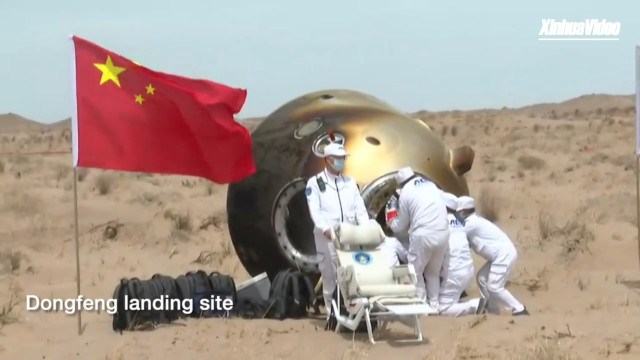
A few hours ago, the three Chinese taikonauts of the Shenzhou 19 mission returned to Earth after spending a little more than six months on the Chinese space station Tiangong, where they arrived on October 29, 2024. The three taikonauts Wang Haoze, Cai Xuzhe, and Song Lingdong had left the station about nine hours earlier to land at a site called Dongfeng in China’s Inner Mongolia Autonomous Region. It’s a procedure that significantly reduces the time to return to Earth and now has become routine.
The original plan was for the three taikonauts to return to Earth yesterday in a different section of the site. However, there were strong winds in that section, and the China Manned Space Agency (CMSA) decided to postpone the landing by a day and move it to the eastern section of the Dongfeng site. This is the first landing in that section, and all personnel have been professional in assisting the taikonauts.
Three spacewalks were performed during the Shenzhou 18 mission. On December 17, 2024, Cai Xuzhe and Song Lingdong set a new record for the longest spacewalk in history among all space agencies with a duration of 9 hours and 6 minutes for the installation of debris protection devices and various equipment maintenance operations. On January 20, 2025, Cai Xuzhe and Song Lingdong spent 8 hours and 17 minutes on the installation of additional debris protection devices and equipment status checks. On March 22, Cai Xuzhe and Song took more than 7 hours to complete the installation of debris protection devices and conduct other device installation operations outside the space station. Lingdong Cai Xuzhe has become the taikonaut with the most extravehicular activities, with a total of five spacewalks.
The taikonauts of the Shenzhou 19 mission conducted many experiments on the Tiangong space station, and several samples were returned to Earth. Among the experiments, there was the first demonstration of in-orbit artificial photosynthesis technology. The production of oxygen is the most obvious result, but there are also ingredients useful for the production of rocket fuel. Considering the ambitions of the Chinese space program, this is a significant achievement.
