
Two articles – available here and here – accepted for publication in “The Astrophysical Journal Letters” report different aspects of the study of supernova SN 2025kg, which generated a so-called fast X-ray transient, a little-known event that in this case was cataloged as EP 250108a. This type of event has now been described as a sort of stifled-at-birth version of a gamma-ray burst.
Two teams of researchers with several members in common used data collected by two instruments on the Einstein Probe space telescope and other instruments to analyze the emissions from this supernova. This allowed them to propose an explanation for the fast X-ray transients (FXTs) and how they differ from gamma-ray bursts.
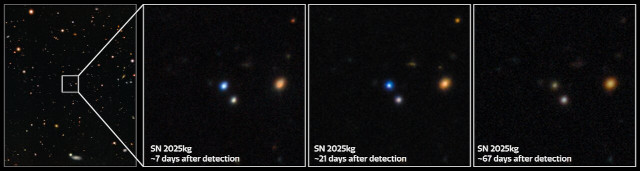
The image sequence (Courtesy of International Gemini Observatory/NOIRLab/NSF/AURA. Acknowledgment: PI: J. Rastinejad (Northwestern University). Image processing: J. Miller & M. Rodriguez (International Gemini Observatory/NSF NOIRLab), M. Zamani (NSF NOIRLab)) shows the fading light of supernova SN 2025kg, followed by the fast X-ray transient EP 250108a, as seen by the Gemini North and South telescopes.
Fast X-ray transients are rare and difficult to observe due to their short duration. For this reason, they’re still poorly understood. The Einstein Probe was designed by the Chinese Academy of Sciences with instruments specialized in X-ray astronomy and is therefore ideal for detecting these emissions. Launched on January 9, 2024, this space telescope observed a fast X-ray transient on January 8, 2025, during supernova SN 2025kg.
Occurring approximately 2.8 billion light-years from Earth, the explosion of that star and its aftermath were also detected by other instruments in various electromagnetic bands. X-ray detections were crucial in discovering the fast X-ray transient associated with that supernova, but the observations of the various emissions allowed a more complete reconstruction of what happened to the star.
The data collected showed a supernova similar to those associated with gamma-ray bursts. The data also indicated that the collimated jets characteristic of gamma-ray bursts were unable to pass through the star’s dying outer layers. They were, so to speak, stifled at birth. In a scientific reconstruction, those jets interacted with the star’s outer layers and decelerated, resulting in their kinetic energy being converted into the X-rays characteristic of fast X-ray transients, which were detected by the Einstein Probe space telescope during supernova SN 2025kg.
These studies open new frontiers in understanding fast X-ray transients in particular and expand our knowledge of the processes that can occur when a star explodes. The value of observations in various electromagnetic bands will also make those conducted by the Vera C. Rubin Observatory, which recently saw its first light, invaluable. For this reason, we can expect new discoveries about these truly violent and spectacular events.
