
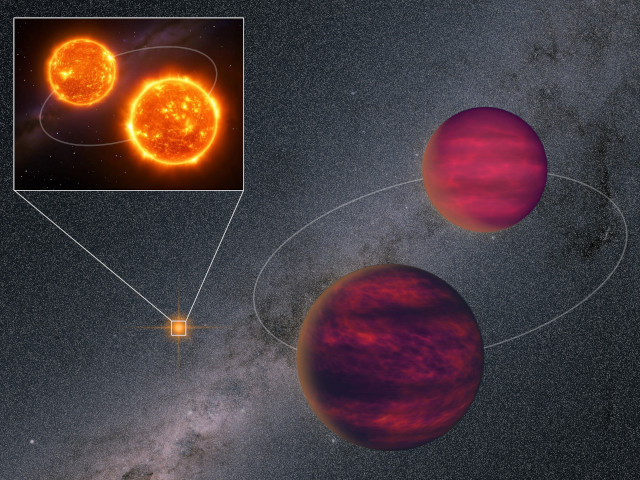
An article published in the journal “Monthly Notices of the Royal Astronomical Society” (MNRAS) reports the discovery of a rare hierarchical quadruple system, which was cataloged as UPM J1040−3551 AabBab. A team of researchers used observations conducted with ESA’s Gaia space probe and NASA’s WISE space telescope, followed by spectroscopic detection and analysis, to identify this quartet consisting of a pair of red dwarfs and a pair of brown dwarfs. This relatively young system may offer new information, especially about brown dwarfs, objects halfway between planets and stars.
The image (Courtesy Jiaxin Zhong/Zenghua Zhang. License CC BY 4.0) shows an artist’s impression of the UPM J1040−3551 AabBab system. On the right side, in the foreground, are the two brown dwarfs cataloged as Ba and Bb. On the right, in the background and in the zoomed inset, are the two red dwarfs, cataloged as Aa and Ab.
The UPM J1040−3551 AabBab system is approximately 82 light-years from Earth. Aab refers to the two red dwarfs, two very similar stars, both having a mass of about 17% the Sun’s. Bab refers to the two brown dwarfs, two much smaller substellar objects. The distance between the two pairs is approximately 1.656 times the distance between the Earth and the Sun. The two pairs orbit a common center of gravity in an estimated period of about 100,000 years.
The researchers conducted complex analyses of the data obtained, including spectroscopic data detected using the Southern Astrophysical Research (SOAR) telescope at the Cerro Tololo Inter-American Observatory in Chile. For the red dwarfs, the observations were obtained at optical frequencies, while for the brown dwarfs, near-infrared measurements were necessary, given that these objects have very faint emissions detectable only in the infrared.
The spectroscopic analyses were crucial in overcoming another difficulty: the extremely long time it takes for the two pairs to orbit their common center of gravity, which made it impossible to assess it only through the motions detected over the course of a few years.
The emissions called H-alpha from the red dwarfs in the UPM J1040−3551 AabBab system suggest it’s relatively young. The age estimates are still rough, ranging from 300 million to 2 billion years.
Hierarchical quadruple systems are rare because two pairs of stars form a stable gravitational bond only under exceptional circumstances. This makes UPM J1040−3551 AabBab interesting, and the presence of two brown dwarfs offers further possibilities for study. These objects, halfway between planets and stars, are still poorly understood due to their extremely faint emissions, which make them difficult to study even with the most powerful and sensitive instruments.
UPM J1040−3551 Ba and Bb offer the possibility of conducting more precise measurements of their orbital motions, which in turn will allow to estimate their masses. All the information gathered will be useful in increasing our knowledge of brown dwarfs.
