
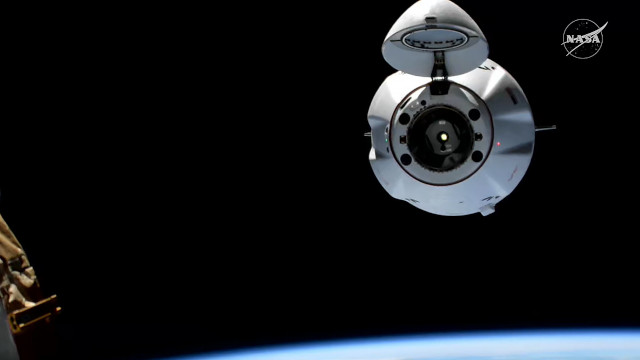
A little while ago, SpaceX’s Dragon 2 spacecraft docked with the International Space Station’s Harmony module completing the first part of its CRS-33 mission. Astronaut Mike Fincke and his colleague Jonny Kim monitored the operation but the cargo spacecraft, which blasted off about 28 hours earlier, completed the maneuvers automatically without any problem.
The Dragon spacecraft’s approach to the International Space Station follows a procedure that has become routine but remains long and delicate. The Station’s safety is the top priority, so every little step of the Dragon gets checked. Only if all goes well in the spacecraft’s position and velocity, they proceed with the next step, and in case of any problems can be aborted at every step. The Dragon 2 carries out all the maneuvers automatically up to the docking, and the procedure can be interrupted until the last moment.
The second version of the Dragon cargo spacecraft can remain in space much longer than the first, but so far, NASA has limited its mission duration to a month and a half. The CRS-33 mission will be the first in which the Dragon cargo spacecraft will remain docked with the International Space Station for a longer period: the departure date is still approximate, but this time, it should arrive in about five months.
The length of the CRS-33 mission is primarily due to the secondary use of this Dragon spacecraft, which will become a new means of re-boosting the International Space Station. For this reason, the unpressurized section also contains two additional Draco engines with their own independent propulsion systems.
A re-boosting test of the International Space Station by a Dragon cargo spacecraft was conducted during the CRS-31 mission on November 8, 2024. This type of maneuver is scheduled to be conducted a few times in the coming months. For years, Russian Progress cargo spacecraft have been used for this task, and now the US can contribute with SpaceX spacecraft.
This use of Dragon spacecraft will also be useful in perfecting the design of a version that will be used to push the Station’s modules into the atmosphere and destroy them when the decision is made to end its life. That might happen in 2030.
