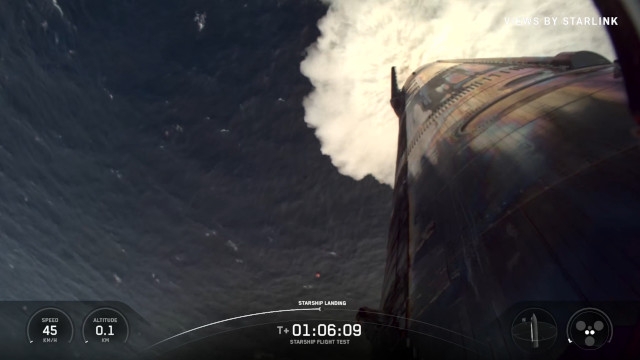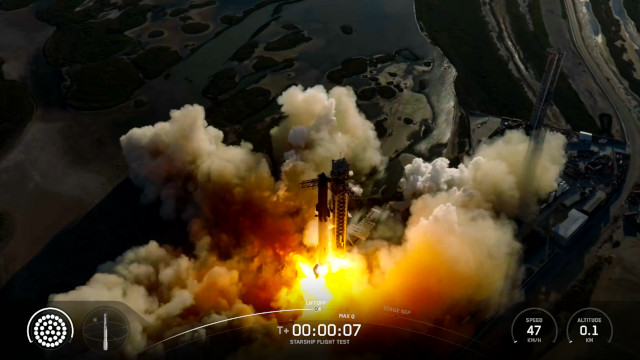
It was the afternoon in the USA when SpaceX conducted a new flight test of its Super Heavy rocket and Starship prototypes, launched from its base in Boca Chica, Texas. This is the 11th test involving the entire system of Elon Musk’s company, which is supposed to revolutionize space travel with an unprecedented transport capacity and being totally reusable. They are advanced prototypes with the Super Heavy identified as Booster 15, at its second flight, and the Starship Block 2 identified as Starship 38 or Ship38 or simply S38.
The 10th test, conducted on August 26, resulted in a successful flight of the Starship, which SpaceX needed to continue the development of this launch system. Yesterday’s test was intended to conduct further tests on the endurance of the vehicles and their engines through various maneuvers. No attempt to land was planned. The Super Heavy was the prototype already used for the 8th test conducted on March 6.
Super Heavy Booster 15 launched normally and conducted a test that, from the outset, had the objective of a splashdown in the Gulf of Mexico. During the maneuver to bring it into the trajectory needed for splashdown, 10 engines were supposed to fire, but one of them failed to ignite properly. However, nine engines were sufficient to complete the necessary maneuvers, which included a few seconds during which the prototype hovered a few meters above the sea.
The Starship Block 2 test was once again eagerly anticipated, having completed a full flight in the 10th test, at last. Once again, the prototype performed its duty. Eight dummy Starlink satellites were deployed again, and a Raptor engine was successfully fired in space.
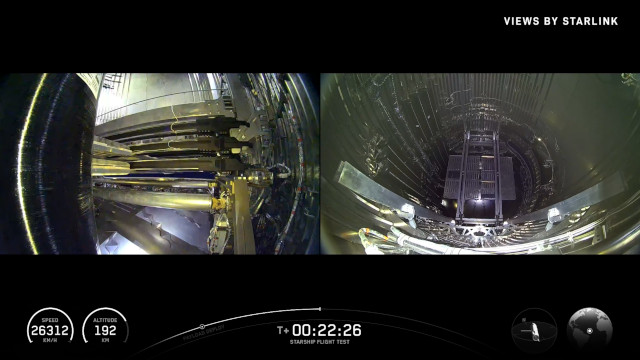
Starship 38’s reentry into the atmosphere was once again designed to stress-test the structure. Some heat shield tiles were removed to assess the hull’s resistance to the severe stresses a vehicle is subjected to during reentry. Despite these severe stresses, the maneuvers that guided Starship 38 to the splashdown area in the Indian Ocean were performed correctly, and the test was successfully completed approximately 66 minutes after liftoff.
This test showed further progress in the development of this launch system. It’s a very positive result for SpaceX, especially considering that the last two successes come after some bad tests for Starship that had already led to rumors of the project’s failure. The next step will be a new phase of testing, with the transition to the Block 3 version of the vehicles and the use of a new launch pad.
We will likely have to wait until next year to see if this launch system will be ready for real missions. The Super Heavy has already proved its ability to land and be reused, and it will be up to the Block 3 Starship to prove this capability, as well as in-flight refueling.