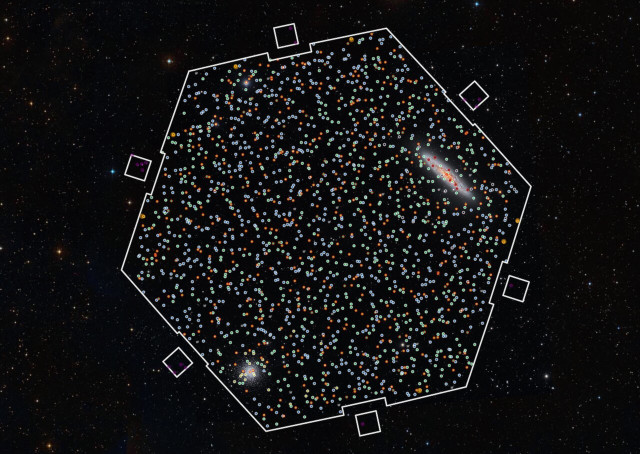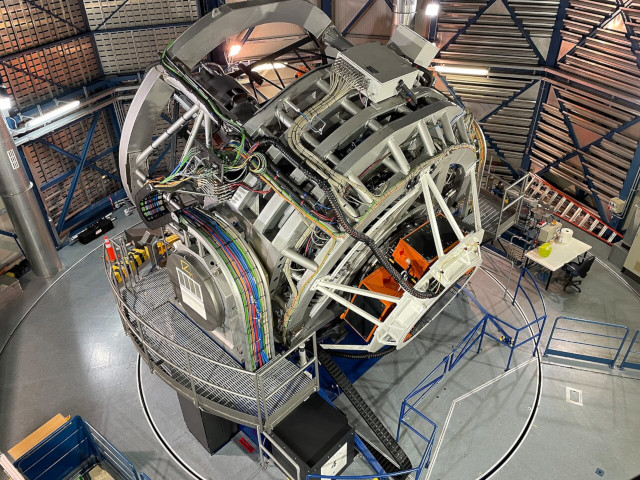
On October 18, the 4-meter Multi-Object Spectroscopic Telescope (4MOST), mounted on ESO’s VISTA telescope in Chile, saw its so-called first light in its initial observation tests. With its system made of 2,436 optical fibers, 4MOST can capture light from a field of view with a diameter of up to 2.5 degrees, which in practice translates to an area equivalent to 16 times the size of the full Moon. The light is directed into three spectrographs that divide it into color components in the visible light range, providing individual spectra. This will enable a cosmological survey encompassing 25 million objects in the first five years of its operation.
The VISTA (Visible and Infrared Survey Telescope for Astronomy) telescope is the largest telescope used for astronomical surveys of the type that map large areas of the sky. Among its instruments was the VIRCAM (VISTA InfraRed CAMera), inaugurated in 2008. It was a remarkable instrument, but astronomers increasingly needed an instrument that could obtain spectroscopic information on many astronomical objects in a short time. This is why the VIRCAM was replaced by an instrument that is very different, and not only in the type of information it collects.
Normally, the VISTA telescope’s instruments observe a single object of study. Instead, 4MOST was designed with a sophisticated system of hair-thin optical fibers that can simultaneously observe light sources for multiple scientific projects. Astronomers struggle to obtain time for the observations they need for their studies, and from this perspective, the 4MOST instrument represents a significant step forward, as it can satisfy many astronomers simultaneously. A further advantage is the ability to quickly reposition the optical fiber system so it can be pointed at a new target in just a few minutes.
The VISTA telescope received several upgrades to accommodate an instrument like 4MOST, precisely because it’s so different from the VIRCAM. This was a complex task, planned and carried out by a consortium of 30 universities and research institutions from around the world, led by the Leibniz Institute for Astrophysics Potsdam (AIP).
The first light, seen on October 18, led to the observation of a large area of sky in just twenty minutes. The two main objects were the Sculptor Galaxy, cataloged as NGC 253, and the galaxy cluster NGC 288. These are recognizable in the bottom image (AIP/Background: Harshwardhan Pathak/Telescope Live) as the two largest “spots” amidst a series of dots.
The spectroscopic surveys to be conducted with the 4MOST instrument anticipate observing approximately 25 million objects during the cosmological survey that will be conducted over the first five years of operations. The information collected will complement that of other studies and surveys.
For example, 4MOST’s data will complement the vast amount of data collected by ESA’s Gaia space probe over more than a decade, which allowed the creation of a map of the Milky Way. 4MOST will allow additional data about the speed at which stars are moving toward or away from Earth.
The data collected by the 4MOST instrument at first light is just a small sample of its capabilities, and to fully appreciate them, access to their analysis is needed. This initial test has already provided exciting results for astronomers, and now 4MOST can begin its true work with five years of investigation for 25 scientific programs spanning various cosmological studies.