
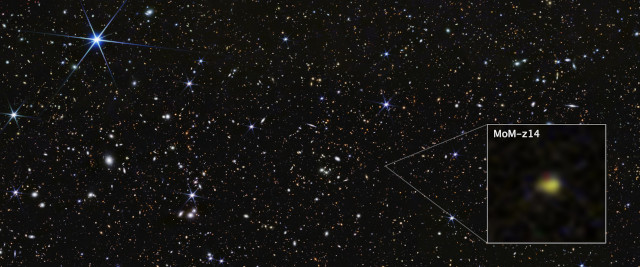
An article accepted for publication in the “Open Journal of Astrophysics” reports evidence that the galaxy MoM-z14 is the most distant known so far. A team of researchers led by the Kavli Institute for Astrophysics and Space Research at the Massachusetts Institute of Technology (MIT) used the James Webb Space Telescope as part of the “Mirage or Miracle” (MoM) survey, in which the NIRSpec instrument was used to verify the nature of very bright and potentially very distant galaxies observed in images captured by the NIRCam instrument. The results confirm that we see MoM-z14 as it was about 280 million years after the Big Bang, confirming again that highly active galaxies existed at that time.
The image (NASA, ESA, CSA, STScI, Rohan Naidu (MIT); Image Processing: Joseph DePasquale (STScI)) shows the galaxy MoM-z14 photographed by the James Webb Space Telescope’s NIRCam (Near-Infrared Camera) instrument with an image from the so-called COSMOS Legacy Field in the background.
One of the goals of the James Webb Space Telescope is to search for the oldest galaxies, to observe the earliest stages of their formation. The ideal would be to find the first stars ever to exist in the universe. So far, it’s finding very old galaxies that are more evolved than expected. Some of them are so distant that it’s difficult to calculate their distance precisely, as was the case with JADES-Gs-z14-1.
The results of the “Mirage or Miracle” survey were surprising, indicating that very ancient light sources exist, far more numerous than current cosmological models predict. These results came when the James Webb Space Telescope was already revealing a primordial universe in which evolved galaxies existed, albeit still very compact.
Spectroscopic analyses made possible by the James Webb Space Telescope’s NIRSpec instrument allow to analyze the redshift, the shift toward the red of observed galaxies due to their moving away from us, which follows the expansion of the universe. Redshift increases with distance, so its analysis is crucial for calculating the distance of a faraway galaxy. In the case of the galaxy MoM-z14, that analysis confirmed that it’s a primordial galaxy, seen as it was approximately 13.5 billion years ago.
Spectroscopic analysis of the galaxy MoM-z14 also allowed to examine its composition thanks to the “chemical signatures” left by the elements in its electromagnetic emissions. This provided a further surprise, as a significant amount of nitrogen was detected at a time when astronomers thought very little of it existed. This means that 280 million years after the Big Bang, generations of stars had already generated that nitrogen and exploded, spreading it around to become part of stars of subsequent generations.
The only existing explanation for such a large amount of nitrogen in the galaxy MoM-z14 is that it’s a consequence of its structure. That type of galaxy was very compact and therefore dense, so it could form supermassive stars in which that nitrogen could be generated.
These primordial yet already evolved galaxies are still difficult to explain with current cosmological models. The researchers proposed some possible explanations, including modifications to those models, such as the lambda-CDM, which is about dark matter. These hypotheses are already being studied by various teams of cosmologists.
Each new confirmation of a primordial galaxy as luminous as MoM-z14 can offer new insights into that phase of the universe’s history. These discoveries bring astronomers closer to the epoch of reionization, when the universe, which previously was dark, became luminous. This study provided the first results from the “Mirage or Miracle” survey, and others will follow. A large sample of such galaxies is crucial to gaining enough information to understand the reasons for their quick evolution.
