
An article published in the journal “Nature Astronomy” reports the discovery of the five nucleobases that form DNA and RNA—adenine, guanine, cytosine, thymine, and uracil—in samples brought back to Earth from asteroid Ryugu. A team of researchers analyzed two of the samples taken by JAXA’s Hayabusa 2 space probe during its mission. The five nucleobases were found in both samples. Just over a year ago, the detection of the five nucleobases in samples brought back from the asteroid Bennu by NASA’s OSIRIS-REx space probe was announced. This provides further confirmation of the presence of life’s building blocks on asteroids, and it’s possible that they seeded the primordial Earth.
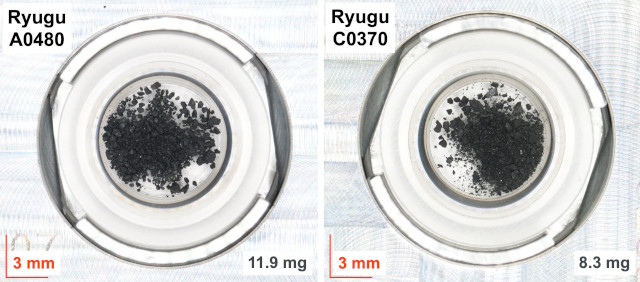
The photo (Courtesy JAXA / JAMSTEC. All rights reserved) shows the samples collected by the Hayabusa 2 space probe on two different occasions from the first and second selected sites on asteroid Ryugu.
The Hayabusa 2 space probe completed its mission on December 5, 2020, with the arrival on Earth of samples collected in previous years from the asteroid Ryugu. The search for life’s building blocks in asteroids is important for reconstructing the early stages of the formation of the first living organisms on Earth. Almost exactly three years ago, the presence of uracil in samples from asteroid Ryugu was announced. Analysis continued, and this study has now led to the detection of all the nucleobases that make up DNA and RNA.
It’s unclear what mechanisms might be behind the formation of complex molecules such as the nucleobases under the conditions found on asteroids, making these studies even more valuable. The issue is further complicated by other findings, such as the discovery of phosphates announced in 2024 in samples from asteroid Bennu, which suggests it was ejected from a primitive world with an ocean.
The authors of this new study compared the results with those obtained from other asteroid samples. Life building blocks were also found in asteroids Orgueil and Murchison, but in those cases, contamination was suspected because they’re asteroids that fell to Earth and thus came into contact with life forms on the planet. The samples brought back from asteroids Ryugu and Bennu arrived on Earth sealed and were handled with the precautions needed to avoid contamination.
The samples from asteroid Bennu are richer in cytosine, thymine, and uracil than in adenine and guanine. In the samples from asteroid Ryugu, the various nucleobases are present in similar quantities. According to the authors of this study, this reflects the different chemical and environmental histories of the two asteroids. The amounts of nucleobases found in asteroid Orgueil are similar to those found in the samples from Bennu, while those found in asteroid Murchison are different from the others, as adenine and guanine are present in greater quantities than cytosine, thymine, and uracil.
An interesting result concerns a possible correlation between the amount of nucleobases and the concentration of ammonia. Toshiki Koga, lead author of this study, explained that there’s no formation mechanism that involves a ratio of ammonia to nucleobases, so this discovery could lead to previously unknown formation mechanisms that were active in the early history of the solar system.
This study provides confirmation of the presence of complex molecules in asteroids, which may have seeded the early Earth. They may have formed on asteroids like Ryugu and Bennu, or perhaps on larger objects like the one from which Bennu originated, and then reached Earth. Each study of the collected samples offers new information, but many questions remain, and analyses continue to answer them. The results will help us better understand the origin of life on Earth and the history of the solar system.
