
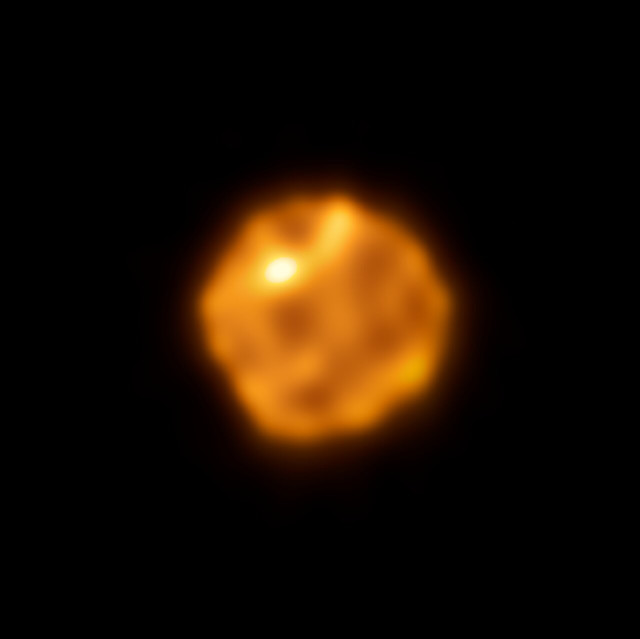
An article accepted for publication in the journal “Astronomy & Astrophysics” reports the results of observations of structures that are lasting longer than predicted in the atmosphere of the star Betelgeuse. A team of researchers used the ALMA radio telescope to obtain some of the most detailed views of Betelgeuse’s surface ever obtained. This allowed them to study its really uneven surface and the structures within its atmosphere.
Betelgeuse has become famous far beyond the field of astronomy in recent years thanks to its brightness variations. The event, nicknamed the Great Dimming because of the sharp dip in brightness, followed by a subsequent rebound, was exceptional even by the standards of a red supergiant.
The recent publication of evidence for the existence of a companion to Betelgeuse has also increased scientific interest in a star that is constantly monitored because it could begin its final phase of contraction before exploding as a supernova at any moment.
For several years, astronomers have been collecting observations of red supergiant stars that are reaching the end of their lives, indicating that their atmospheres are uneven. Essentially, bubbles of extremely hot gas rise from the depths of this type of star and create inhomogeneities in the form of hot spots. This means that Betelgeuse also has a non-homogeneous surface and an irregular shape. On the contrary, a star like the Sun has a much more regular shape.
Observations with the Atacama Large Millimeter/submillimeter Array (ALMA) radio telescope were conducted in August 2023. The results confirm the irregularities on its surface. Its photosphere has an average temperature of around 2,300 Kelvin and includes two significantly hotter regions. The hottest and brightest area, called a hotspot in jargon, is about 800 Kelvin hotter than the surrounding area.
Interestingly, the hotspot was already observed in 2015, again with the ALMA radio telescope, which was used in a configuration similar to the one used in 2023. This result was surprising because current models of the evolution of red supergiants don’t predict the existence of such long-lasting structures.
One hypothesis for the persistence of this hotspot is linked to the orbit of a possible companion to Betelgeuse, whose gravity could influence what happens in its atmosphere. The most convincing evidence for the existence of that companion was published a few weeks ago, and the data could help us better understand what’s happening in Betelgeuse’s atmosphere.
Several observation campaigns of Betelgeuse have provided a broader and more complete picture of the processes at work in the final phase of this star’s life. It’s not possible to predict when the final phase, which will lead to a supernova, will begin, and for this reason, astronomers will continue to monitor it, trying to better understand the mechanisms behind the observed processes.
