
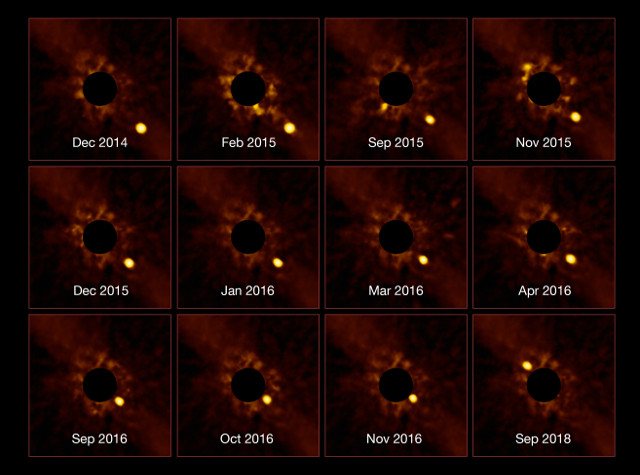
ESO has published a time-laps composition of images showing the exoplanet Beta Pictoris b while orbiting its star. It was discovered in 2008 using the NACO instrument mounted on the VLT in Chile and the team led by Dr. Anne-Marie Lagrange who discovered it kept on studying it some years later using the SPHERE instrument, which in the meantime was also mounted on the VLT. The researchers lost sight of it when it approached its star’s halo too closely to be resolved by any current instrument but got visible again in September 2018.
About 63 light years away from Earth, the exoplanet Beta Pictoris b orbits its star, which is about 75% larger and more massive than the Sun, in an orbit similar to Saturn’s. That system is very young in astronomical terms and the exoplanet has a mass that is several times that of Jupiter even if the estimates made over the years are quite different. According to an estimate reported in the journal “Nature Astronomy” in August 2018 combining data collected by the Hipparcos and Gaia satellites, its mass is between 9 and 13 times Jupiter’s.
The characteristics of the Beta Pictoris b exoplanet make it suitable to be photographed directly with instruments developed at least in part for this purpose. The NACO (NAOS + CONICA, Nasmyth Adaptive Optics System + Near-Infrared Imager and Spectrograph) instrument mounted on the Very Large Telescope (VLT) photographed it in 2003 but only subsequent image processing systems made it possible to notice its presence in 2008. In 2013 it was photographed during the tests of another instrument, the Gemini Planet Imager (GPI) mounted on the Gemini South telescope in Chile, which officially entered service in January 2014.
When the SPHERE instrument was activated, in June 2014, the researchers used that one as well to observe the exoplanet Beta Pictoris b from December of that year. For about two years they monitored its orbit but later it got too close to its star’s star for any of current instrument to be able to resolve it. Only in September 2018 Beta Pictoris b moved away from its star enough to be visible again.
The impossibility of resolving a planet not far enough from a star is a limit for instruments such as SPHERE or GPI but for the visible planets they represent an important aid for astronomers. That’s because they allow to study those exoplanets in a more in-depth and continuous way, exactly as in the case of Beta Pictoris b, to better understand their characteristics.
There are other similar instruments such as the WIRCam (Wide-field InfraRed Camera) mounted on the Canada-France-Hawaii Telescope (CFHT) and in July 2018 the discovery of the exoplanet 2MASS J0249-0557 c was announced, whose spectroscopic analysis revealed characteristics very similar to those of Beta Pictoris b. The discoverers theorized that their systems were born in the same stellar nursery and then moved away from each other. The two planets are similar but 2MASS J0249-0557 orbits a pair of brown dwarfs and not a normal star.
These are among the results of the use of instruments that directly photograph exoplanets. The first planets out of the solar system were discovered in the 1990s, so their study is a branch of astronomy that’s still new and booming. The possibility of following the motion of an exoplanet such as Beta Pictoris b is one of the frontiers in this type of study.
