
 NASA’s New Horizons spacecraft has just completed its flyby of the object known as 2014 MU69 and nicknamed Ultima Thule. The automatic program to proceed with the photos and the other detections of its target was activated a few days ago so, after sending the last images taken when it was still almost two million kilometers away, New Horizons aimed its instruments at Ultima Thule. If all went well, in the next few hours it will communicate it to the mission control center and start sending the data it collected, a process that will continue for an estimated time in about 20 months.
After the extraordinary Pluto flyby on July 4, 2015, the New Horizons space probe continued to move away from the Sun into the Kuiper Belt. In 2014, the Hubble Space Telescope discovered the object cataloged as 2014 MU69, which was later chosen as the target of New Horizons’ second mission. In March 2018, NASA announced its decision to give this object the nickname Ultima Thule, but it will not be possible to assign an official name until there’s certainty about its nature of single or multiple object. This is one of the answers that only a flyby can provide.
The fact that within a few hours of the New Horizons space probe’s flyby there’s relatively little information on Ultima Thule makes this event even more interesting. Alan Stern of the Southwest Research Institute, the mission’s principal investigator, stressed the fact that this object is still an enigma and at this point we must hope that everything works well to get answers.
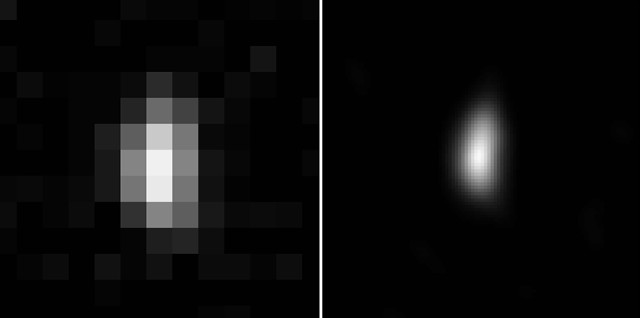
The image (NASA/Johns Hopkins University Applied Physics Laboratory/Southwest Research Institute) captured by the New Horizons space probe on December 30 at a distance of about 1.9 million kilometers still shows very roughly the shape of Ultima Thule. The raw image on the left side is only a set of a few pixels, but it was possible to apply refinement techniques by combining multiple images, obtaining the shape visible on the right side. The result confirms that Ultima Thule has an elongated shape but it’s still impossible to tell whether it’s a single object or a number of objects very close or even in contact.
Ultima Thule is considered a kind of fossil left over from the first phase in the solar system’s history. In the outer area of the solar system known as the Kuiper Belt, Neptune’s gravitational interference made much more difficult for asteroids to coalesce into larger objects. Dwarf planets formed and astronomers are still trying to figure out how many there are and some think there may be a planet but there are mainly asteroids.
The interest in Kuiper Belt objects is connected to the planet formation processes but the presence of water detected in some of the known ones leads to further studies. Today we know that there are underground oceans in moons such as Europa and Enceladus and there may have been other of them in places such as the dwarf planets Ceres and Pluto and in the moon Charon. At this point, many wonder if there may be conditions for even dwarf planets in the Kuiper Belt to have underground oceans where there might be conditions for life forms to emerge.
Smaller objects like Ultima Thule can give us an idea of the composition of the larger ones and may have remained almost unchanged for billions of years. The New Horizons space probe’s flyby was much closer than Pluto’s because it’s a much smaller target but this means that even a small rock near Ultima Thule would destroy New Horizons in the event of a collision since it’s traveling to about 14 km/s.
NASA’s activities are very limited due to the American government shutdown but the Johns Hopkins University Applied Physics Laboratory, which collaborates with the New Horizons mission, is at work. This means that if the flyby went well in the coming days we can hope to see the first quality photos of Ultima Thule. Given the low transmission speed, it will take about 20 months to receive all data. Meanwhile, at NASA they’re already thinking at a further mission for New Horizons, even farther away into deep space.

Permalink
Permalink
Permalink
Permalink
Permalink