
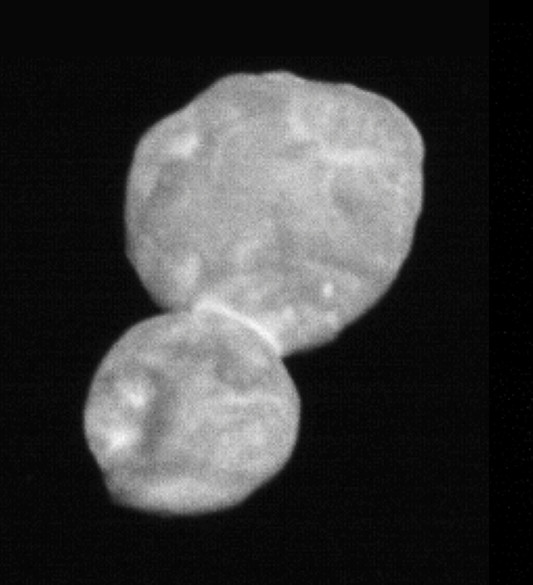
 NASA published the first detailed images of the Kuiper Belt object cataloged as 2014 MU69 and nicknamed Ultima Thule. Captured by the New Horizons space probe’s LORRI and MVIC instruments approximately 90 to 30 minutes before its closest approach, they finally clearly show this object’s double-lobe structure. In jargon, it’s called a contact binary and is the result of two close objects that collide at low speed and end up merging. The larger lobe has been nicknamed Ultima and the smaller Thule.
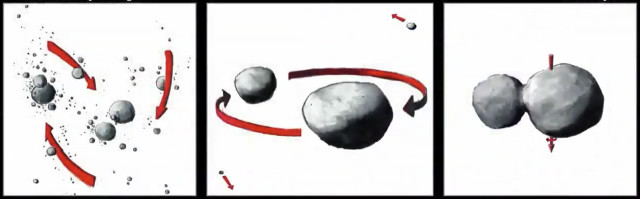
After the Ultima Thule flyby on January 1, 2019, the New Horizons space probe started transmitting the data collected to Earth, but given the very low speed possible from that distance, it took more than a day to see images close enough to finally establish this object’s shape. In the end it turned out to be a contact binary, a common case in the Kuiper Belt and also known thanks to the comet 67P/Churyumov-Gerasimenko, which probably formed similarly to Ultima Thule. The image right below (NASA/JHUAPL/SwRI/James Tuttle Keane) shows the possible mechanism that leads to the formation of this type of object from different objects with close orbits.
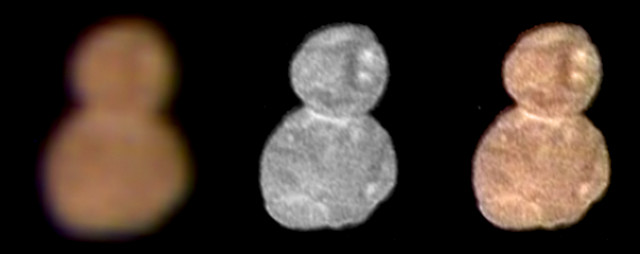
Immediately the public started looking for Ultima Thule’s similarity to a snowman, a bowling pin, the BB-8 droid and more. The top image (NASA/Johns Hopkins University Applied Physics Laboratory/Southwest Research Institute) was captured by the Long-Range Reconnaissance Imager (LORRI) instrument when the New Horizons space probe was about 28,000 kilometers (18,000 miles) away. The bottom image (NASA/Johns Hopkins University Applied Physics Laboratory/Southwest Research Institute) shows on the left the first color image of Ultima Thule captured by the Multispectral Visible Imaging Camera (MVIC) instrument at about 137,000 kilometers (85,000 miles), at the center image captured by LORRI and at the right a combination of the two images.
Jeff Moore, a scientist at NASA’s Ames Research Center and a member of the New Horizons mission, stated that Ultima Thule is one of the first planetesimals, the building blocks that in the first phase of the solar system’s history coalesced into larger objects. In this case there are only two building blocks, in other cases they kept on coalescing and formed planets and dwarf planets.
The color photo allowed to confirm Ultima Thule’s reddish color already seen by telescopes. One of the hypotheses is that it’s generated by tholins, the same compounds that redden a part of the surface Pluto’s great moon Charon. It remains to understand the process that leads the tholins to settle on the surface but this will require more data, the ones that will arrive over time.

Permalink