
 In a press briefing that included a number of scientists working on NASA’s New Horizons mission, the first discoveries on the Kuiper Belt object cataloged as 2014 MU69 and nicknamed Ultima Thule were presented, obtained thanks to data received during the January 1, 2019 flyby. They’re based on information that’s still incomplete, which could be contradicted by high resolution photos and other data but for the moment this object doesn’t appear to have neither moons nor rings, or at least not of relevant sizes, no impact craters were found on its surface nor were traces of atmosphere.
In this first phase of the reception of the data collected by the New Horizons space probe every new photo can offer big news. The information will keep on arriving for about 20 months offering a constantly improving pictures of one of the building blocks left over from the age of the formation of planets, dwarf planets and other larger objects in the solar system. For now the information received seems to be more about what’s not on Ultima Thule and around this object than what can be found there.
The little that was clear in the images received is Ultima Thule’s reddish color. Even over 6.5 billion kilometers (more than 4 billion miles) away, the Sun’s ultraviolet emissions can cause chemical reactions generating compounds such as tholins. The “neck”, the area where the two objects joined together to form this two-lobe asteroid nicknamed Ultima and Thule, has a lighter color, indicating that in that area the materials could have a different composition or a different size of the grains since the smaller ones reflect light more than the larger ones. In short, even in this case there are still more questions than answers.
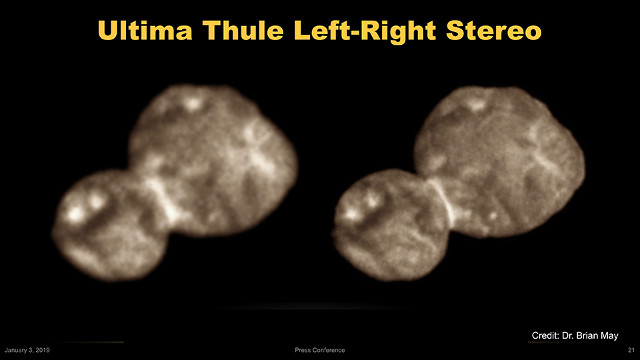
Thanks to the availability of good quality images, it was possible to create the first 3D reconstructions of Ultima Thule in various versions. Brian May is dividing his activity between his work of a musician with a celebratory song – bottom video – and an astrophysicist and in this capacity he created the side by side image (NASA/Johns Hopkins University Applied Physics Laboratory/Southwest Research Institute) ).
What until now seems absent in the Ultima Thule flyby are moons or rings but it’s possible that they’re too small to be visible in the phots received so far. You can’t see craters on its surface either and again they could be small but Thule, the smaller lobe, has a large lump that will certainly be the object of more detailed studies along with other similar geological features on both lobes when high definition images and other data arrive. The lack of traces of atmosphere was expected given this object’s small size but the data that will arrive will be analyzed to see if there are any volatile compounds that sublimate even at that distance from the Sun releasing gas.
During the briefing, Alan Stern, the principal investigator of the New Horizons mission, said that the interference of the Sun, which for a few days will be between the Earth and the space probe, will prevent data transmission until January 10. It’s a blackout a little shorter than previously estimated. In the meantime, the American government shutdown is slowing down the work, which is still being carried out by other entities that collaborate with NASA such as the Johns Hopkins University Applied Physics Laboratory.
