
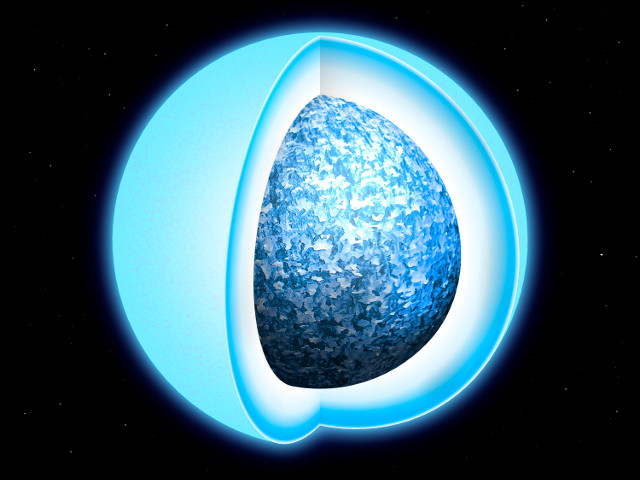
An article published in “Nature” shows the evidence that in white dwarfs oxygen and carbon slowly crystallize from their cores. A team of researchers used data collected by ESA’s Gaia space probe that include distance, brightness and color of hundreds of thousands of white dwarfs analyzing over 15,000 candidates within 300 light years away from Earth to collect evidence of the crystallization process. This is the first verification of a prediction dating back to the beginning of the 1960s.
White dwarfs are the final phase of the life of a star of small and medium-small mass and this also means the Sun’s. After the agony of the red giant phase, the outer layers are expelled and at that point the core is inert because it’s incapable to support nuclear fusion of elements such as carbon and oxygen. If the remaining mass of a non-rotating core is less than 1.44 solar masses the core collapses but at levels far from those of a neutron star: the final volume of a white dwarf is comparable to the Earth’s while a neutrons have a radius of a dozen kilometers.
A white dwarf cools down over a very long time and at the end of that process becomes a black dwarf, a theoretical stage since no object has yet been discovered even near it. Scientists estimate that it takes billions of years for a white dwarf to cool off completely and according to this new research the timescale could be even longer. Basically, it’s possible that at this moment none of them has yet reached the final stage of black dwarf.
At the beginning of the 1960s some scientists predicted that the cooling of a white dwarf would lead to its crystallization starting from its core because of the enormous pressures electrons becoming unbound from atoms leaving charged nuclei that are in fluid form until the temperature is down to 10 million degrees allowing solidification into crystals. This process generates energy slowing down the cooling with the consequence that there should be a concentration of white dwarfs of certain colors and brightness.
Over time, several attempts have been made to find evidence of this process of crystallization but there weren’t enough data, a situation that changed considerably. In April 2018 ESA published the so-called Data Release 2 (DR2) of Gaia, ESA’s space probe that is mapping cosmic objects with unprecedented accuracy, including hundreds of thousands of white dwarfs.
So far, the temperature of a white dwarf has been used as an indicator of its age because astronomers believed that their cooling was very regular. The very precise data collected by the Gaia space probe indicate that there is an abnormal concentration of white dwarfs with characteristics of color and brightness that match the phase in which the heat should be released abundantly. This means that there is the expected slowdown in their cooling phase, which can be extended even by two billion years.
Dr. Pier-Emmanuel Tremblay of the University of Warwick, the research’s lead author, explained that according to his team, energy is generated because oxygen crystallizes and then sinks into the core, comparing the process to the sedimentation of a river bed. The consequence is that carbon is pushed upward, releasing gravitational energy. He also pointed out that before the mapping carried out by the Gaia space probe, precise information on the distance and brightness of 100-200 white dwarfs was available, now there are information on about 200,000 of them.
In essence, this is precisely the kind of research that gained enormous benefits from the Gaia space probe’s work, a fact stressed by Timo Prusti, a scientist of the Gaia mission at ESA. The information now available allowed to reconstruct the relationship between the mass of white dwarfs and their cooling rate, which is faster in the more massive ones. The oldest are probably almost completely crystallized. All this will allow to measure with greater precision the age of white dwarfs and better understand the Sun’s final destiny.

Permalink