 Two articles, one to be published in the journal “The Astrophysical Journal” and one in the journal “Monthly Notices of the Royal Astronomical Society”, describe studies of an anomalous event and an object cataloged as AT2018cow and therefore nicknamed “The Cow”. According to a team led by Raffaella Margutti of Northwestern University, who produced the article to be published in “The Astrophysical Journal”, it could be an anomalous supernova, tens of times brighter than normal that generated a black hole or a neutron star, while another team led by Paul Kuin of University College London (UCL), who produced the article to be published in “Monthly Notices of the Royal Astronomical Society”, it could be a black hole that destroyed a star.
On 17 June 2018, in the CGCG 137-068 dwarf galaxy, about 200 million light years from Earth, the twin ATLAS telescopes in Hawaii detected the extremely bright event cataloged as AT2018cow. The brightness of this transient object was tens of times greater than that of a supernova and, moreover, it had a very short duration, fading away much faster than a normal supernova after emitting most of its energy. Materials were ejected at a speed of around 30,000 km/s, about a tenth of the speed of light.
Supernovae always attract the interest of astronomers, one so extraordinary did that even more with the consequence that after a few days many other telescopes were observing AT2018cow increasing day after day for the duration of the transient event and even beyond to try to understand what was left after its end.
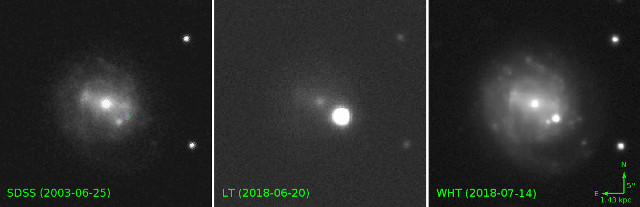
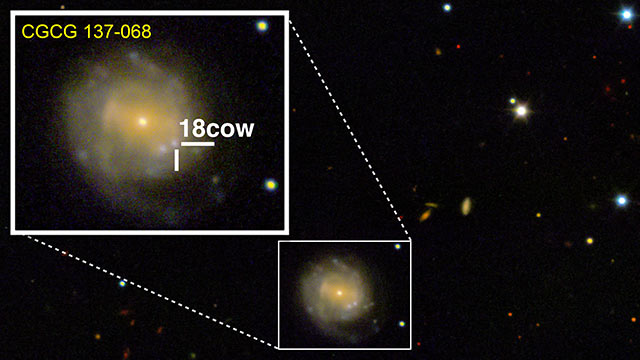
The top image (courtesy Raffaella Margutti/Northwestern University) shows an observation by the W.M. Keck Observatory in Hawaii showing AT2018cow 80 days after the initial explosion. The bottom image (Daniel Perley, Liverpool John Moores University) shows various observations of the galaxy in which the event was detected: on the left in the Sloan Digital Sky Survey with a green circle where it appeared in June 2018, at the center the Liverpool Telescope shows the event on June 20, 2018 and on the right the William Herschel Telescope shows the event about a month later.
Paul Kuin’s team obtained information ranging from infrareds to gamma rays. Raffaella Margutti’s team used information from a greater number of telescopes and for this reason they span the electromagnetic spectrum from radio waves to gamma rays. This allowed to understand at least some of its characteristics but with very different conclusions.
Spectroscopic analysis allowed Raffaella Margutti’s team to discover the chemical signatures of hydrogen and helium, normal in the case of a supernova with the outer layers of the star that are ejected into space but incompatible with the presence of two neutron stars that merged generating a kilonova. The analysis of a lot of data led the researchers to conclude that AT2018cow left an amount of materials about ten times lower than a normal supernova and that the debris were asymmetric.
Generally the materials around a supernova partially obscure it, but in the case of AT2018cow all the electromagnetic emissions were able to pass through at least in certain areas, including the one pointed towards the Earth. According to the reconstruction of Raffaella Margutti’s team, the exploded star’s core started interacting with the debris, attracting them in a whirling motion. Not everything is still clear, starting with the conditions that determined the asymmetries in the materials that, instead of forming a shell around the core, left it half-naked. That core collapsed after the supernova but from the analysis of the data it’s still unclear whether it’s a black hole or a magnetar-type neutron star.
According to Paul Kuin’s it was instead a tidal disruption event in which a black hole destroyed a star. Amy Lien, of NASA’s Goddard Space Flight Center, part of that team, explained that they think that such an event created that anomalous burst of light and is the one that best explains the multifrequency observations of the Swift space telescope after the light started fading.
According to that team the black hole destroyed a white dwarf, what remains after a star of medium or small mass finished its normal phase of life compressed in a volume comparable to the Earth’s. According to them, the black hole has a mass between 100,000 and a million times the Sun’s, close to that of supermassive black holes at the center of galaxies.
Despite the many observations of the AT2018cow event, there are two very different interpretations and this shows how difficult it can be to understand an anomalous event like this one. The area continues to be under observation to understand if there is a black hole, and in that case to try to understand whether it’s what remains of a star or it has a much higher mass, or a neutron star, essential to establish what happened.