An article published in “The Astrophysical Journal” reports a study of an area containing a number of star clusters that have a common origin even if their formation had slightly different timescales in the various regions. A team of researchers used NASA’s Spitzer space telescope and Chandra X-ray Observatory to examine the many different objects present between the regions known as Cepheus C and Cepheus B and map the cluster called Cep OB3b.
The Spitzer Space Telescope Infrared Array Camera (IRAC) and Multi-band Imaging Photometer System (MIPS) instruments were used in 2009, during the so-called cold mission conducted before it ran out of the liquid helium used as a coolant. When the researchers examined them understanding the full extent of the structure they mapped the Cep OB3b cluster using data collected by the Chandra X-ray Observatory’s Advanced CCD Imaging Spectrometer (ACIS) instrument.
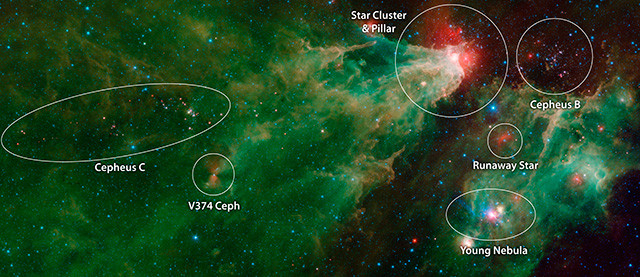
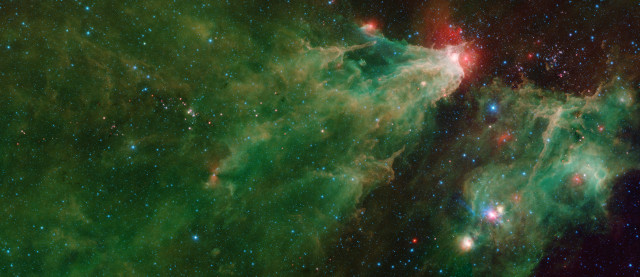
The images (NASA/JPL-Caltech) are occupied mainly by a green and partly orange structure, a nebula composed of gas and dust which was part of a much larger one dug over time by the radiation emitted by nearby stars. The bright area is illuminated by massive stars part of a cluster called Cep OB3b that extends over the white spot, the result of a combination of blue, green, orange and red colors that represent infrared wavelengths, respectively 3, 6, 4.5, 5.8 and 8 microns. The red glow was generated by dusts heated by stellar radiation.
On the left side of the images, a dark filament crosses horizontally the green cloud with newborn stars indicated by the red and yellow dots inside it. That’s Cepheus C, a region about 6 light years long with a particular concentration of gas and dust where stars are formed.
The small red hourglass-shaped region under Cepheus C is V374 Ceph, surrounded by a disk of dark dusty materials that maybe form an almost edge-on disk. The dark cones extend towards the sides of the star and form a shadow of that disk.
The smaller nebula on the right side of the images is Cepheus B, containing stars with an age estimated between 4 and 5 million years, slightly older than the ones in Cepheus C. The area includes a blue star with a small bright red arc around it. That’s a runaway star that’s passing through gas and dust at high speed creating a shock wave called “bow shock” in front of itself. At the bottom there’s a young nebula containing a small cluster of newborn stars.
The processing of the data collected by the Spitzer space telescope offers an extraordinary panorama of that region showing various star clusters born in various parts of the original cloud. The amount of gas still present will probably give birth to many more stars in the future, making that region even brighter and also offering more precious details of those processes.