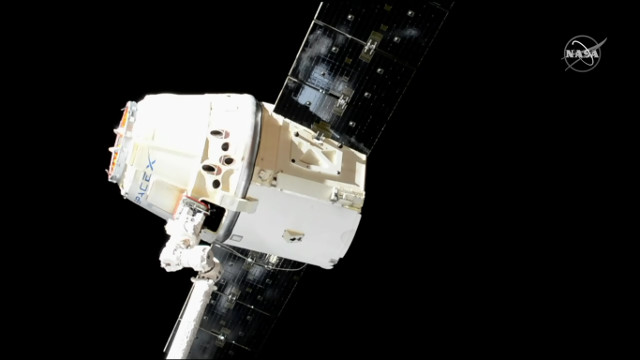
A few hours ago the SpaceX Dragon spacecraft ended its CRS-17 (Cargo Resupply Service 17) mission for NASA splashing down smoothly in the Pacific Ocean a little more than 325 kilometers (about 202 miles) off the coast of California. The Dragon left the International Space Station a few hours earlier.
Shortly after landing, SpaceX boats went to retrieve the Dragon to transport it to the coast. The cargo brought back to Earth will be delivered to NASA soon, probably tomorrow. The Dragon spacecraft reached the International Space Station on May 6, 2019.
The Dragon spacecraft brought back to Earth more than 1,900 kg (aabout 4,200 lbs) of mixed cargo between the pressurized and the non-pressurized section that include various scientific experiments and biological samples. Part of the samples are contained in the freezers because they need to be kept at low temperatures.
SpaceX is the only American company that has a spacecraft that can bring intact cargo back to Earth so the Dragon missions are really important for NASA. Samples produced during many of the experiments conducted on the International Space Station may require in-depth analyzes possible only in specialized laboratories on Earth.
Medical research, other biological research and experiments of other types are conducted on the Station. When they need to bring something back to Earth a little cargo can be transported together with the astronauts on the Soyuz spacecraft but their total volume requires a cargo spacecraft that can bring them back to Earth.
Biophysics-6 is one of the recently conducted medical experiments that require bringing results back to Earth. It’s about the production of proteins that are interesting in treatments against forms of cancer and in protection against radiation. In microgravity some proteins can grow larger and with less imperfections.
The Microalgae Biosynthesis Biological in Microgravity (MicroAlgae) experiment studies the effects of microgravity on an algae of the species Haematococcus pluvialis, which produces a powerful antioxidant called astaxanthin that could be an excellent supplement for astronauts. If this algae can grow normally in space this supplement could be produced directly by astronauts.
On May 23, 2019 the CRISPR/Cas9 genetic technique, which in recent years has become used a lot, was used for the first time in space to modify a genome in the Genes in Space 6 experiment. It’s part of the experiments that aim to understand how DNA repair mechanisms work in space.
The next resupply mission for the Dragon cargo spacecraft could begin as early as July 2019, although launch dates are always approximate. For the moment they have to verify that samples and experiments returned to Earth undamaged.

Permalink