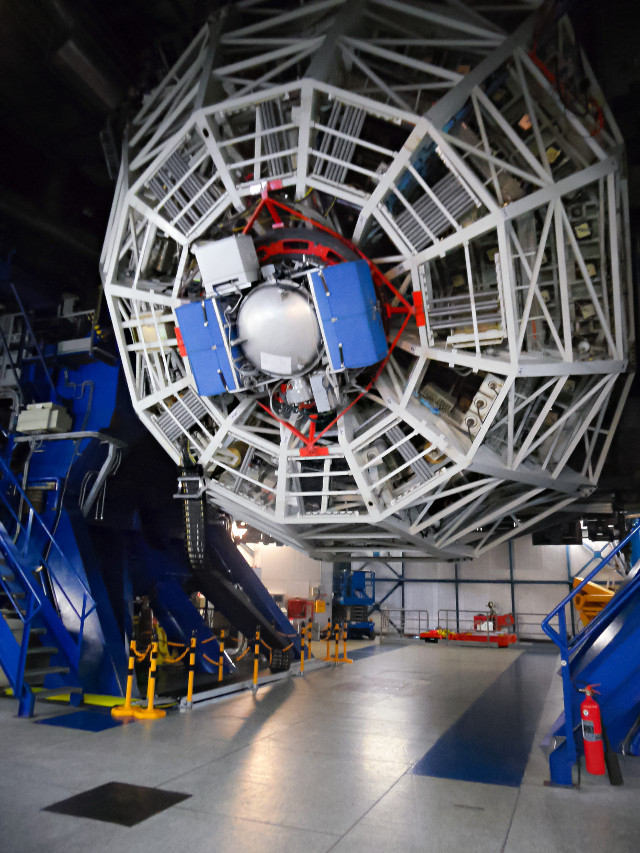
The NEAR (Near Earths in the AlphaCen Region) instrument mounted on the ESO VTL in Chile saw the so-called first light, which means that it made its first observation after being activated. This instrument is designed to detect exoplanets in the Alpha Centauri system, made up of two stars which, together with their farther and smaller companion Proxima, are the closest to the Sun at a distance of about 4.3 light years. ESO collaborated in this project with the Breakthrough Watch program.
The two main stars of the Alpha Centauri system have sizes similar to the Sun’s but so far an exoplanet has only been discovered orbiting Proxima, which is a red dwarf and, despite its small size, emits powerful flares. Alpha Centauri A and Alpha Centauri B are close and it’s not clear if a planet could orbit them in a stable way.
Despite the doubts, the Alpha Centauri system has been the subject of many studies and projects for sending space probes. Starshot is one of those projects, announced in April 2016 by Russian entrepreneur Yuri Milner as part of Breakthrough Initiatives, which also includes Breakthrough Watch. The collaboration with ESO and other organizations from various countries led to the NEAR project, a thermal infrared coronograph that aims to block most of the light coming from a star and to capture the infrared light emitted by an exoplanet.
The NEAR instrument was installed on one of the four 8-meter-diameter telescopes of the VLT (Very Large Telescope), the one identified as UT4. This meant an update and a modification to an existing instrument, VISIR (VLT Imager and Spectrometer for mid-Infrared), to optimize the sensitivity to infrareds associated with potentially habitable exoplanets. The consequence is that it will be able to look for thermal traces similar to the Earth’s, which absorbs energy from the Sun and emits it in the field of thermal infrareds. A coronograph that blocks the light of the observed star and adaptive optics are solutions already used for another VLT instrument to study exoplanets, SPHERE, activated in June 2014. NEAR also uses new strategies to reduce noise and allow to switch from one star to another as fast as every 100 milliseconds.
Today the first campaign of observations of the Alpha Centauri system with the NEAR instrument is ending. Astronomers predict that an exoplanet of at least twice the size of the Earth is detectable, the analysis of the collected data will tell them if traces matching planets have been found. Smaller planets could escape detection so the lack of traces wouldn’t mean that the two stars have no planets for sure.
There’s great interest in the results of this research on the star system closest to the Sun. In recent years there were some announcements of the possible detection of exoplanets in the Alpha Centauri system but they remained without confirmation. The hope is to discover a rocky planet in the system’s habitable zone but even if there were any they’d still be too far away to get there quickly.