
An article published in the journal “The Astrophysical Journal” offers a new definition of the habitable zone of a star system where a planet that can accommodate life forms similar to the Earth’s can orbit. A team of researchers coordinated by the University of California – Riverside examined the available data on the atmospheres of exoplanets with orbits in what until now has been considered the habitable zone discovering that in most cases there’s an amount of carbon dioxide and carbon monoxide toxic for complex life forms as we know them. In essence, the new definition significantly reduces the habitable zone.
In the last few years the number of known exoplanets has increased exponentially thanks to new generation instruments that have now discovered a few thousand of them. Among them there are many rocky planets, generally super-Earths but in some cases similar in size to the Earth and in lucky cases even smaller. This made it possible to carry out follow-up studies to examin their characteristics, including the presence and possible composition of an atmosphere, and begin to understand which are really potentially habitable. In some cases exoplanets with interesting features were even defined as Earth’s twins, are their similarities really so profound or were they hasty definitions?
The current knowledge is incomplete even with regard to the planets of the solar system, one of the reasons why there are researchers who are trying to reconstruct their history. The Earth is habitable because it has a magnetic field that protects it and an atmosphere with the right characteristics, including a good percentage of oxygen. Venus is at the inner border of what has been considered the solar system’s habitable zone but turned into hell due to a runaway greenhouse effect, Mars is on the outer border of that zone but it’s a small planet that cooled down relatively quickly with the consequence that it lost its magnetic field and solar wind started sweeping away its atmosphere, turning it into the arid world we know today.
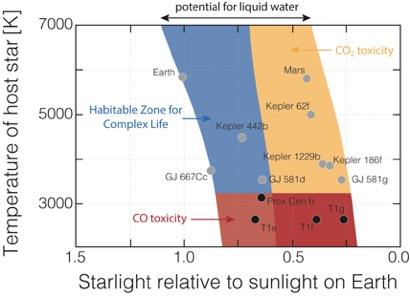
Many scientists are trying to understand what makes a planet more stable and hospitable to life forms and are examining various characteristics. The authors of this new research believe that carbon dioxide and carbon monoxide are key gases in those assessments. The chart in the image (Courtesy University of California – Riverside. All rights reserved) shows the definition of habitability that they proposed, in which the habitable zone for complex life is shown in blue while the planets they don’t consider habitable anymore are shown in yellow in case of abundance of carbon dioxide and in red in case of abundance of carbon monoxide.
Carbon dioxide is a greenhouse gas that can be useful on a planet that otherwise wouldn’t be warm enough to have liquid water on its surface. However, the first author of the research Edward Schwieterman explained that to have liquid water on a planet at the outer border of what has been considered so far the habitable zone it would need an amount of carbon dioxide tens of thousands of times higher than that present on Earth. This would be much higher than the toxic level for humans and animals.
The issue of carbon monoxide is complex. The authors of this research together with other colleagues published in March 2019 a previous article in the journal “The Astrophysical Journal” in which they concluded that that gas can be compatible with the presence of life forms, albeit elementary. The problem is again that higher levels become toxic for complex life forms.
These assessments lead to negative indications for planets that orbit small stars whose emissions favor the concentration of carbon monoxide whereas the emissions of stars like the Sun destroy it quickly. For example, planets that orbit a red dwarf like Proxima Centauri and an ultra-cool dwarf like TRAPPIST-1 have high chances of having strong concentrations of carbon monoxide in their atmospheres.
This study offers limited perspectives in the search for complex life forms but we’re talking about Earth-like planets and there are various factors to consider. When they were young, both Venus and Mars were much more similar to the Earth so the results of the study of exoplanets’ atmospheres can be very different depending on their age.
Rocky planets remain the least difficult to examine but life forms could also exist in oceans beneath the surface of gas giants’ moons but no moon has yet been confirmed in other star systems. This shows the difficulties existing in examining the possibilities existing in a vast universe in which we have just started seeing our neighborhood.
