
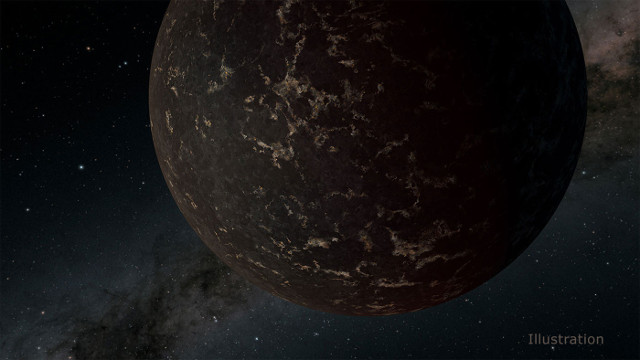
An article published in the journal “Nature” reports a study of the exoplanet LHS 3844b, a super-Earth discovered in 2018 thanks to NASA’s TESS space telescope. For this targeted study, a team of researchers led by Laura Kreidberg of the Harvard and Smithsonian Center for Astrophysics used the Spitzer space telescope to examine its surface and see if it had an atmosphere. The result is that LHS 3844b probably doesn’t have an atmosphere or it’s very thin and is perhaps covered by materials of volcanic origin such as the lunar “mare”. In essence, more than a super-Earth it could be a super-Mercury.
At a distance of about 48.6 light-years from Earth, the exoplanet LHS 3844b has a diameter that’s about 1.3 times the Earth’s. Its year lasts only 11 hours, one of the shortest known, and this places it in the ultra-short period exoplanet class with an average distance from its star of about 932,000 kilometers, less than twice the average distance of the Moon from the Earth.
The star LHS 3844 is a red dwarf with a mass that’s about 15% the Sun’s, really small and with a surface temperature that’s about half the Sun’s. However, a planet as close as LHS 3844b gets still heated a lot, to be precise the face turned towards it since it’s tidally locked, like the Moon with respect to the Earth. The temperature on the dayside was estimated around 770° Celsius.
It was obvious from its discovery that the planet LHS 3844b was too close to its star to have liquid water on its surface with the potential to develop life forms similar to those on Earth. However, planetary scientists are very interested in understanding the possible evolution of a rocky planet, regardless of its potential habitability, so this exoplanet was also the subject of a follow-up study.
The high temperature on the dayside of the planet LHS 3844b generates an infrared emission that can be detected by the Spitzer Space Telescope’s Infrared Array Camera (IRAC) and for this research it was observed for over one hundred hours between February 4 and 8, 2019.
The main result of the observations is the considerable temperature difference between the planet LHS 3844b’s dayside and nightside. If it were a super-Venus, with a very dense and hot atmosphere, there would be winds that would transfer the heat received from the star to the nightside so the whole planet would be very hot. The fact that the nightside is very cold indicates that the planet probably has no atmosphere or it’s very thin.
There are some stellar and planetary properties in which the planet LHS 3844b can have an atmosphere comparable to Earth’s but it’s very unlikely. It’s possible that it originally had an atmosphere but that it was swept away by the stellar wind.
The study of the planet LHS 3844b also showed that it’s rather dark and this suggests that it’s covered with basalt, a type of rock of volcanic origin. That’s another characteristic that indicates that it’s a super-Mercury, therefore a barren land.
Red dwarfs are the most common stars and astronomers are discovering many exoplanets around them so it’s important to study them. These stars are small but especially when they’re young can be very active, a significant problem for their potential habitability. In the case of LHS 3844b a negative result is still useful to improve the models of planetary evolution.
