
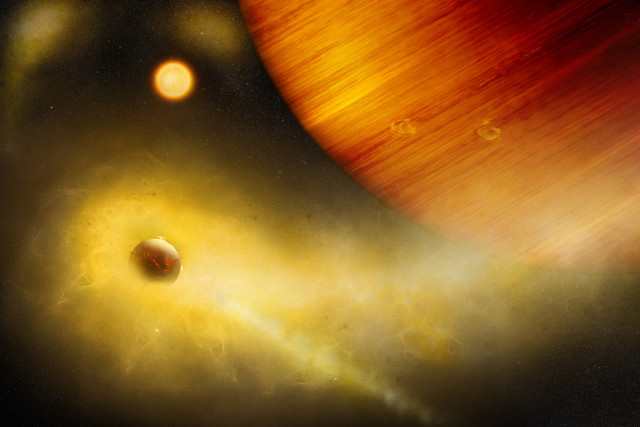
An article accepted for publication in “The Astrophysical Journal” reports on traces of sodium and potassium in the orbit of the gas giant exoplanet WASP-49b. A team of researchers coordinated by the Swiss University of Bern compared the situation of WASP-49b to Jupiter and its moon Io, known for its remarkable volcanic activity, noting that there are important clues to the fact that WASP-49b also has a volcanic moon with an activity that includes the ejection of sodium and potassium.
The search for exomoons is one of the frontiers of astronomy and recently some studies offered clues to their presence in some star systems but not yet proof. The various clues were collected using various methods that can still be improved, also by searching for different exomoon candidates. In the case of the exoplanet WASP-49b, a team led by Apurva Oza of the University of Bern tried to identify the traces of the activity of an exomoon.
About 550 light years from the Earth, the exoplanet WASP-49b is of the gaseous type with a mass that is about 38% of Jupiter’s but very close to its star – which has a mass and size very close to the Sun’s – less than 4% of the Earth’s distance from the Sun. The consequence is that WASP-49b is a hot Jupiter since it gets heated up a lot by its star.
Among the studies concerning the exoplanet WASP-49b, the spectroscopic one called HEARTS (Hot Exoplanet Atmospheres Resolved with Transit Spectroscopy) reported in an article published in the journal “Astronomy & Astrophysics” in May 2017 was focused on the atmosphere of hot exoplanets and allowed to detect the presence of sodium at very high altitudes on WASP-49b.
Theoretical studies already showed years ago the possibility that large amounts of sodium in an exoplanet could indicate the presence of a moon or a ring but in the last decade astronomy was still in the initial phase of the search for exoplanets. Now sodium, combined with the presence of potassium, around the exoplanet WASP-49b was interpreted as the possible presence of an exomoon that is losing large amounts of mass due to a high volcanic activity.
The comparison is with Io, one of the great Jupiter’s moon. Io gets heated by Jupiter’s tidal forces to the point of being the object with the greatest volcanic activity in the solar system. Sodium and potassium are elements ejected by Io’s volcanoes and have a chemical “signature” that is very bright in spectroscopic detections, a great help for astronomers who study other star systems. A volcanic rocky moon can emit more sodium and potassium than a giant gas planet, especially at high altitudes, the situation found around the exoplanet WASP-49b.
The presence of a moon defined as exo-Io because it would be an exomoon similar to Io is an explanation consistent with the data collected on the sodium and potassium around the exoplanet WASP-49b but it’s not the only one. It could for example be an ionized gas ring. For this reason Apurva Oza stated that his team needs more clues.
The case of the exoplanet WASP-49b is particularly interesting but the researchers also examined data about other exoplanets finding possible exo-Io candidates around WASP-76b, HD189733b, HD209458b, and WASP-69b. Follow-up studies are needed to try to understand whether there are exomoons, rings or other processes generated the presence of sodium.
If there were indeed moons of the exo-Io type, a further study will concern the loss of mass due to volcanic activity, which could even lead to their destruction. These are studies that still have various margins of improvement with the hope of really discovering some exomoon and to better understand the conditions in which a hot Jupiter can have a stable moon.
