
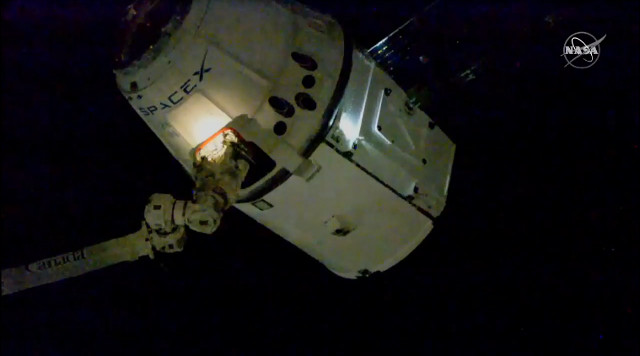
A little while ago SpaceX’s Dragon spacecraft was captured by the Canadarm2 robotic arm on the International Space Station. Commander Luca Parmitano, assisted by his colleagues Andrew Morgan and Jessica Meir, managed the operation then started moving the Dragon to the berthing point at the Harmony module. The cargo spacecraft blasted off last Thursday.
The Dragon spacecraft’s approach to the International Space Station follows a procedure that has become routine but remains long and delicate. The Station’s safety is the top priority so every little step of the Dragon gets checked. Only if all goes well in the spacecraft’s position and velocity they proceed with the next step and in case of any problems can be aborted at every step.
Generally, the International Space Station crew open a cargo spacecraft’s hatch and start unloading its contents the day after its arrival but tomorrow another one is arriving, the Russian Progress MS-13. The consequence is that the crew will proceed with the unloading operations of two cargo spacecraft in the coming days.
Some activities on the International Space Station will be affected by these cargo spacecraft’s arrivals. The scientific activities depend on the experiments that arrive but there’s also hardware that must be installed. For example, the Dragon carries a lithium ion battery to replace one of those that arrived last year that got damaged by a short circuit that occurred after its installation. A spacewalk is required to install these batteries so this operation must be scheduled to be carried out together with other tasks outside the Station.
The Dragon will leave the International Space Station with its new cargo. The CRS-19 mission will be completed with its descent into the Pacific Ocean, off California’s coast. This last phase is important as well because various in-depth analyzes of samples can be carried out only in specialized labs on Earth.
The first part of the CRS-19 mission had no problems and the Dragon cargo spacecraft is performing its third mission. The use of a new Falcon 9 rocket’s first stage seems strange together with the controlled landing on an automated drone ship after providing a thrust longer than usual to allow the second stage to remain in flight for a longer time to collect data on its performance over several hours of flight.

Permalink
Permalink