
An article to be published in “The Astronomical Journal” reports a study on three gas exoplanets discovered in the Kepler 51 system belonging to a rare type that has a very low density even by the standards of these planets. A team of researchers led by Jessica Libby-Roberts, a graduate student at the University of Colorado, Boulder, used the Hubble Space Telescope to study those three exoplanets confirming their density so low as to deserve nicknames such as “cotton candy planets” or “super puffs”. This study suggests that they’re quickly losing mass so in the distant future they could turn into mini-Neptunes, a much more common category.
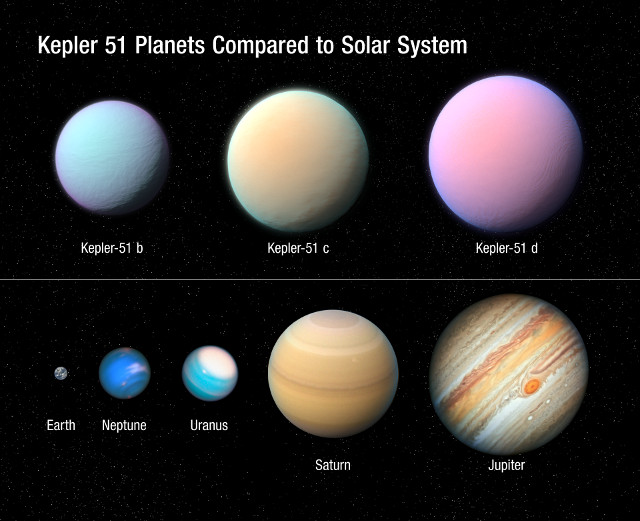
About 2,600 light years from Earth, the system of Kepler 51, also known as KOI-620, is young in astronomical terms since its age was estimated at around half a billion years. This system was studied during the mission of NASA’s Kepler space telescope, which discovered the three strange gas planets in 2012. They have sizes comparable to those of Saturn and Jupiter but their masses were estimated at one hundredth of those of the two solar system’s gas giants. The first estimates of their strange characteristics were made in 2014, to the great surprise of astronomers, and have now been independently confirmed with these new observations made using the Hubble Space Telescope.
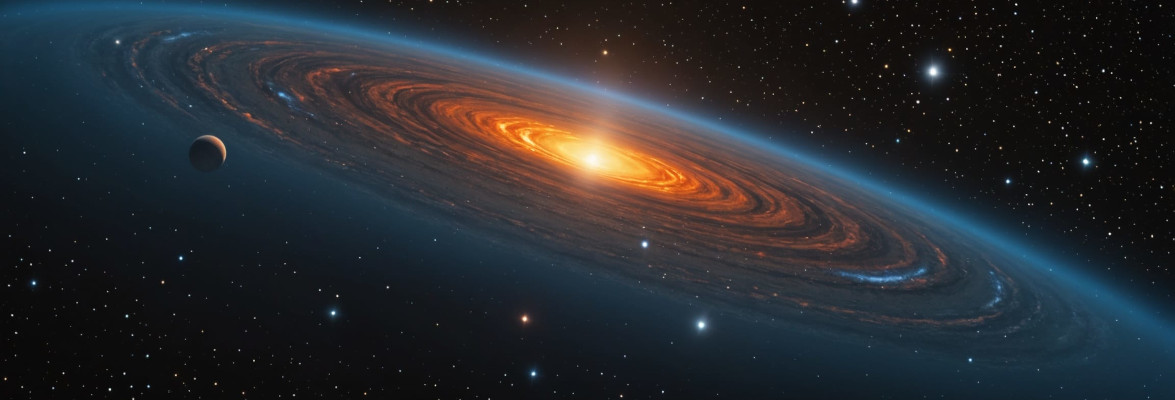
The top image (NASA, ESA, and L. Hustak, J. Olmsted, D. Player and F. Summers (STScI)) shows an artist’s concept of the Kepler 51 system with its three gas giant planets. The bottom image (NASA, ESA, and L. Hustak and J. Olmsted (STScI)) shows a size representation of the Kepler 51 system’s exoplanets compared to the solar system’s planet.
The study of Kepler 51’s three exoplanets showed that they have an atmosphere of hydrogen and helium so swollen that their sizes are comparable to Jupiter’s despite having a much lower mass, around a hundredth of Jupiter’s.
The spectral analysis of the light coming from those exoplanets captured by the Hubble space telescope showed that it doesn’t contain significant chemical traces. That’s surprising considering that gas planets typically contain various chemical compounds, starting with water. One possibility is that their atmospheres contain crystals of some salt or photochemical hazes. This characteristic could be related to their temperature because the colder a planet the cloudier its atmosphere becomes.
According to the researchers, these exoplanets’ low density is related to their age, very young in astronomical terms. They may have formed further away from their star and then got closer, a link to the theme of planetary migration, at the center of various researches thanks to the continuous discovery of new exoplanets. The greater amount of heat received by a Sun-like star could erode their atmosphere and in the distant future at least the innermost exoplanet, Kepler 51 b, could turn into a mini-Neptune.
The Kepler 51 system will be at the center of more studies in the future, especially when new generation instruments will come into service and will allow them to be examined in greater depth. These exoplanets are very interesting to better understand the evolutionary processes of gas planets.

Permalink