
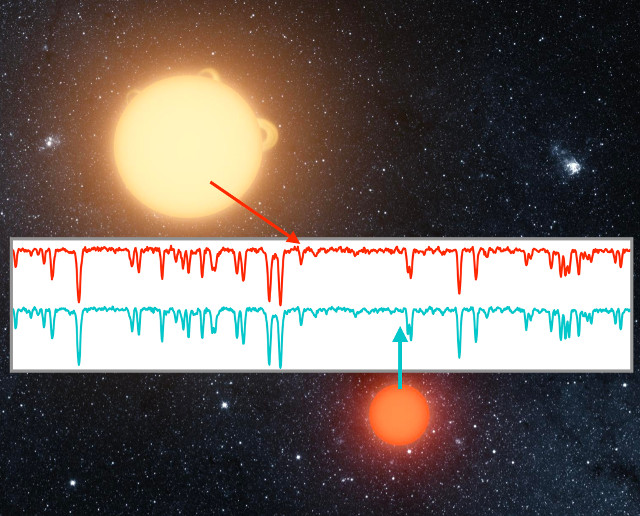
An article accepted for publication in the journal “The Monthly Notices of the Royal Astronomical Society” reports a study on wide binary stars. A team of researchers led by Keith Hawkins of the University of Texas, Austin, studied 25 pairs of wide binary stars identified using data collected by ESA’s Gaia space probe. Using the Harlan J. Smith telescope at the McDonald Observatory, the researchers examined in depth the chemical composition of the 50 stars, concluding that stars born together show a practically identical chemical composition, much closer than randomly chosen stars of the same type.
Binary systems are the most common but the distance between their stars is extremely variable. There are pairs of stars very close to each other but there are also many with significant distances and various theories have been proposed to explain their formation, to the point that astronomers believe that there are various mechanisms to form that type of pair. The wide binaries with a separation between a hundred and a few thousand times the distance between the Earth and the Sun probably formed through fragments of the protoplanetary disk core, as reported in an article published in November 2010 in “The Astrophysical Journal”, while the ones with even greater separations probably formed through various mechanisms ranging from the evolution of unstable triple systems to the dissolution of star clusters.
To try to understand if wide binary stars have an identical or only similar chemical composition and therefore if they are twins or “only” siblings, Keith Hawkins’ team studied 25 pairs. The selection was made using the Data Release 2 (DR2) created thanks to the observations by the Gaia space probe, published by ESA on April 25, 2018.
The spectrometric detections of the 50 selected stars made using the Harlan J. Smith telescope at the McDonald Observatory made it possible to obtain the chemical signatures of the various elements contained in those stars. They’re very indicative of the composition of the cloud in which those stars were formed but to what extent are those stars similar? The image (Courtesy K. Hawkins/UT Austin (data) and NASA/JPL-Caltech/T. Pyle (background)) shows the virtually identical spectral data of a wide binary pair superimposed on an artist concept of a binary star. An in-depth examination of the 25 pairs’ spectra showed that stars born together have a practically identical composition, even when they’re not very close.
This study offers astronomers various possibilities for other research of various kinds. One possibility may be the reconstruction of the history of the Milky Way or part of it in what’s called galactic archeology by identifying stars that were born together and then separated and ended up at very high distances. Another possibility is the study of specific pairs of stars in which one is difficult to analyze, such as red dwarfs that return spectral analyzes that contain many molecular signatures and have easier-to-analyze companions. The growing database created thanks to the Gaia space probe offered the foundations for an in-depth study at unprecedented levels of wide binary systems.
